
Small Business Ideas for Women: 25+ Opportunities to Start and Grow
Starting a business does not have to follow one particular path. Some women may want to build a full-time company, […]


Starting a business does not have to follow one particular path. Some women may want to build a full-time company, while others may prefer freelancing, a side business, an online service, a local operation, or a product-based business.
The right choice depends on your skills, experience, budget, available time, location, customer demand, and long-term goals.
If you are researching small business ideas for women, this guide will help you compare different business models without assuming that one type of business is right for everyone. You will find online, home-based, local, service-based, creative, professional, and product-focused opportunities, along with practical guidance for choosing, testing, and developing an idea.
If you want to explore the wider topic first, see our complete guide to small business ideas.
The goal is not to find an idea that sounds exciting on paper. It is to find an opportunity that fits your circumstances and solves a real customer problem.
What Makes a Business a Good Fit?
A business can be popular and still be a poor fit for a particular person. Instead of choosing an idea simply because other people are doing it, evaluate how well it matches your resources and objectives.
Skills
Start with what you already know. Writing, accounting, design, technology, teaching, organization, sales, cooking, photography, administration, or practical skills can all become the foundation of a business.
Existing skills may reduce the learning curve, although additional training can still be necessary.
Experience
Previous employment, freelance work, education, hobbies, or personal experience can reveal useful business opportunities.
For example, someone with experience managing business schedules may have a foundation for virtual assistance, while someone experienced in marketing may explore consulting or digital marketing services.
Budget
Consider how much you can realistically invest without putting unnecessary financial pressure on yourself.
Service businesses may sometimes require fewer upfront resources than inventory-heavy businesses, but this varies by model.
Time
Some businesses can be performed remotely or scheduled around other commitments. Others require fixed operating hours, travel, inventory management, or appointments.
Choose a model that fits the amount of time you can consistently provide.
Customer Demand
A good idea needs customers with a genuine problem or need.
Before spending heavily, research whether people already buy similar products or services and what they expect from providers.
Competition
Competition is not automatically a reason to avoid an idea. It can indicate that customers already understand the product or service.
The more useful question is how your offer could be different, more convenient, more specialized, or better suited to a particular customer group.
Business Model
Decide whether you want to sell:
- Services
- Physical products
- Digital products
- Subscriptions
- Consulting
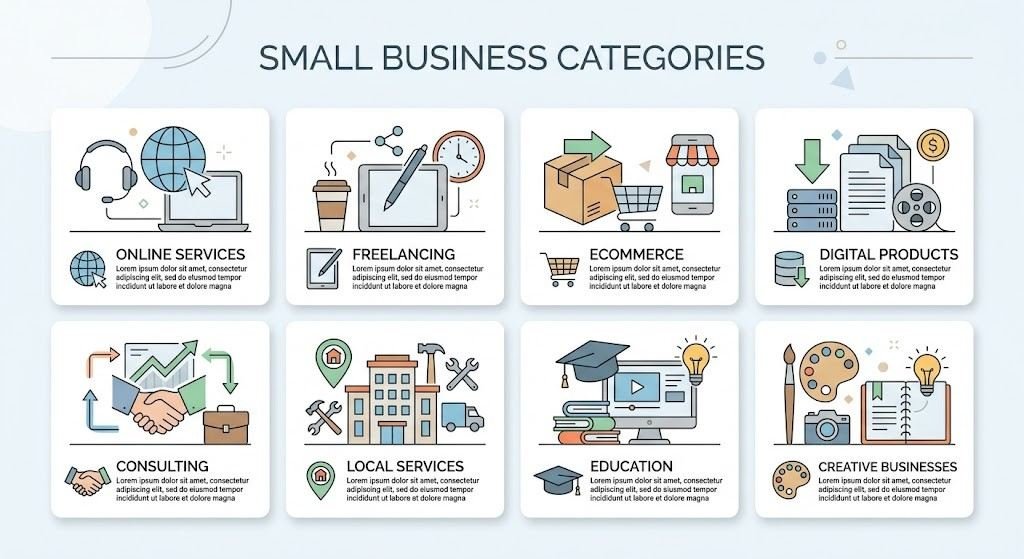
- Education
- Local services
- Online services
- A combination of these
Growth Potential
Some businesses are intentionally designed to remain small and flexible. Others can potentially grow into agencies, teams, stores, or larger operations.
You do not need to build a large company for a business to be worthwhile.
Personal Fit
Consider whether you actually want to perform the work involved.
A business should fit not only your skills but also your preferred working style, customer interaction, schedule, risk tolerance, and goals.
Best Small Business Ideas for Women
The following opportunities cover different skills, business models, budgets, and working arrangements. None is guaranteed to succeed. The right option depends on demand, competition, execution, pricing, operating costs, and the individual behind the business.
1. Freelance Writing
Freelance writing can include blog articles, website content, copywriting, product descriptions, newsletters, editing, and other written material.
It may suit someone with strong writing and research skills who wants an online business.
A writer can specialize in a subject such as technology, finance, real estate, education, or ecommerce rather than trying to serve every industry.
Startup considerations can include a computer, reliable internet, writing software, a portfolio, and a professional way to communicate with clients.
Clients can be found through networking, freelance platforms, direct outreach, referrals, and useful content that demonstrates expertise.
The business can be home-based and online, while recurring customers may come from ongoing content or editing contracts. It can also scale by developing specialized packages or eventually building a small content team.
2. Virtual Assistant Services
Virtual assistants provide administrative and operational support to individuals or businesses.
Tasks may include:
- Email management
- Scheduling
- Research
- Data organization
- Customer communication
- Document preparation
- Calendar management
- Basic content administration
This model can suit someone who is organized and comfortable working with digital tools.
A freelancer can begin with general services and later specialize in areas such as real estate administration, ecommerce support, podcast management, or CRM administration.
The business is often home-based and online. Recurring monthly clients can be possible because administrative work frequently continues after the initial project.
With documented processes and additional team members, a solo virtual assistant can potentially develop an agency.
3. Online Tutoring
Online tutoring can cover school subjects, languages, test preparation, computer skills, professional subjects, or other areas where the tutor has appropriate knowledge.
The strongest opportunity usually comes from solving a specific learning need rather than offering completely general tutoring.
Qualifications may be important depending on the subject, level, and location.
A tutor can work from home using video conferencing and digital teaching materials. Local tutoring can also be offered in person where appropriate.
Customer acquisition can come from referrals, educational communities, local outreach, content, and tutoring platforms.
Recurring customers may be possible when students need ongoing lessons.
4. Graphic Design
Graphic designers create visual materials such as:
- Social media graphics
- Presentations
- Marketing materials
- Packaging
- Brochures
- Brand assets
- Advertising designs
This business may suit someone with strong visual communication skills and familiarity with design software.
A portfolio is often more useful than a long list of general services. Specializing in a particular type of client can also make positioning clearer.
The business can usually be operated online and from home. Recurring work may come from businesses that regularly need marketing materials.
Scaling can involve creating design packages, increasing specialization, or building a small creative team.
5. Web Design Services
Web designers can build websites for small businesses, professionals, ecommerce companies, organizations, and individuals.
Possible services include:
- Business websites
- Personal websites
- Ecommerce sites
- Landing pages
- Website redesigns
- Maintenance and updates
This model can suit someone with web design, WordPress, development, UX, or related technical skills.
A designer can start with a focused service and later add maintenance, hosting coordination, conversion improvements, or ongoing support.
The business is generally online and home-based. Customers can be found through local business outreach, referrals, networking, search visibility, and professional portfolios.
6. SEO Services
SEO services can include keyword research, on-page optimization, local SEO, content optimization, technical SEO basics, internal linking, and SEO strategy.
The business requires genuine knowledge because clients depend on accurate recommendations.
Avoid promising rankings or specific traffic increases. Search performance can be affected by competition, search-engine changes, website quality, content, technical factors, and many other variables.
SEO can be operated remotely and may generate recurring work through monthly optimization and reporting.
A freelancer can eventually specialize in a particular industry or develop an SEO agency.
7. Social Media Management
Social media managers help businesses maintain a consistent presence on social platforms.
Services can include:
- Content planning
- Scheduling
- Publishing
- Community management
- Basic reporting
- Content strategy
This may suit someone who understands social platforms, communication, content planning, and basic analytics.
Instead of simply selling “more posts,” a stronger service focuses on business objectives such as consistency, audience engagement, content organization, or campaign support.
The business can be home-based and online. Monthly retainers may be possible when clients need ongoing management.
8. Online Consulting
Consulting allows professionals to sell specialized knowledge rather than physical products.
Potential areas include:
- Business
- Marketing
- Human resources
- Operations
- Technology
- Career development
- Customer service
- Process improvement
Consulting should be based on genuine knowledge and experience. Certain professional areas may also have qualification or regulatory requirements.
A consultant can begin with one clearly defined problem and one target customer group.
The model can be home-based, online, and potentially scalable through workshops, training programs, documentation, or additional consultants.
9. Bookkeeping Services
Bookkeeping services can include transaction records, expense tracking, account organization, reconciliation, and basic financial reporting.
This business may suit someone with accounting or bookkeeping knowledge.
Professional requirements vary by location and by the exact services being offered, so check applicable rules before advertising regulated services.
Bookkeeping can be performed remotely and may have recurring customer potential because businesses need ongoing record management.
Customers can be found through local business networking, professional referrals, direct outreach, and partnerships with other business professionals.
10. Digital Marketing Services
Digital marketing can combine several services, including:
- SEO
- Email marketing
- Content marketing
- Social media
- Paid advertising
- Conversion-focused website improvements
A successful service should focus on measurable business objectives rather than simply producing more content.
The business can begin with one specialized service and expand later.
For example, someone with strong SEO skills might initially offer local SEO before adding content strategy or technical services.
Online delivery makes this model suitable for remote work, while recurring contracts can provide ongoing service opportunities.
11. Online Course Creation
An online course can turn existing expertise into structured educational content.
Possible subjects include professional skills, software, language learning, creative skills, business knowledge, or practical hobbies.
A strong course should solve a specific problem for a defined audience.
Creating the lessons is only part of the business. Marketing, audience development, student support, updates, and customer experience also matter.
Courses can be operated from home and sold online. The model can potentially scale because the same educational material can serve multiple customers, although sales are not automatic.
12. Digital Products
Digital products can include:
- Templates
- Planners
- Checklists
- Spreadsheets
- Printables
- Guides
- Design resources
This model may suit someone who can create useful resources for a specific audience.
The main work includes identifying a problem, creating the product, testing it, setting pricing, choosing a distribution method, and marketing it.
Digital products do not require physical inventory, but they still require time and resources.
They can be sold online and potentially generate repeat sales without producing each item individually.
13. Handmade Products
Handmade businesses can include crafts, personalized gifts, home décor, accessories, artwork, and other physical products.
The business may suit someone with an established creative or production skill.
Important considerations include:
- Materials
- Production time
- Inventory
- Packaging
- Shipping
- Product photography
- Customer service
Selling can happen through an ecommerce website, marketplaces, local markets, or suitable retail partnerships.
A handmade business can begin at a small scale, but production capacity becomes important as orders increase.
14. Online Reselling
Online reselling involves sourcing products and selling them through an online marketplace, website, or other appropriate channel.
The work includes:
- Product sourcing
- Listing
- Pricing
- Photography
- Customer service
- Fulfillment
- Returns
The main challenge is not simply finding products. It is understanding demand, sourcing costs, marketplace rules, shipping, returns, and competition.
Reselling can be home-based, although inventory may eventually require additional storage.
15. Ecommerce Store
An ecommerce business sells physical products through a website or marketplace.
A store can focus on a particular niche rather than attempting to sell everything.
Before purchasing substantial inventory, research:
- Customer demand
- Competition
- Product costs
- Shipping
- Returns
- Packaging
- Customer acquisition
- Platform fees
Ecommerce can be more operationally complex than many service businesses because products must be sourced, stored, fulfilled, and supported.
However, it can potentially scale through additional products, improved systems, and broader customer acquisition.
16. Home Bakery
A home bakery can specialize in cakes, cookies, specialty baked goods, desserts, or event orders.
This can be attractive for someone with strong baking and customer-service skills, but food businesses require more than culinary ability.
Depending on the location, requirements may include food-safety rules, permits, inspections, labeling, zoning restrictions, and appropriate facilities.
Before accepting orders, research local requirements carefully.
Customer acquisition can come from local networking, referrals, social media, community events, and partnerships where permitted.
17. Catering Services
Catering businesses can serve private celebrations, corporate events, parties, weddings, and other gatherings.
A caterer needs to manage more than food preparation. Planning, purchasing, transportation, staffing, food safety, packaging, scheduling, and customer communication are all important.
Local regulations may apply to food preparation and commercial catering.
Specialization can help, such as focusing on a particular type of event, cuisine, or service format.
Recurring business may come from corporate clients or organizations with regular events, depending on the market.
18. Sewing and Clothing Alterations
Sewing skills can become a service business through:
- Clothing alterations
- Repairs
- Custom garments
- Small-batch products
- Event clothing
- Personalized items
This model may suit someone who already has sewing equipment and practical experience.
Alterations can be particularly different from selling finished products because customers are paying for a specific service.
The business can be home-based where local rules permit. Customer acquisition can come through referrals, local searches, community networks, clothing businesses, and partnerships.
19. Photography Services
Photography businesses can focus on:
- Portraits
- Events
- Product photography
- Business photography
- Real estate
- Personal branding
Equipment requirements depend heavily on the service offered.
A strong portfolio is important because customers need to see the quality and style of the work before booking.
Local networking can be valuable for event and portrait photography, while product and business photography can also be marketed online.
Recurring work may come from businesses that need updated images regularly.
20. Video Editing and Content Production
Video editing can serve YouTube creators, businesses, agencies, educators, and social media publishers.
Services may include:
- Long-form video editing
- Short-form clips
- YouTube editing
- Captions
- Social media content
- Basic motion graphics
- Content repurposing
This business can often be operated remotely.
The main requirements are appropriate editing software, a capable computer, reliable storage, and relevant skills.
Specializing in one type of content can make customer acquisition easier.
21. Beauty or Personal Care Services
Beauty businesses can include hair services, makeup, nail services, or other personal-care treatments where legally permitted.
The important issue is compliance. Depending on the service and location, licensing, hygiene standards, safety requirements, insurance, inspections, and professional qualifications may apply.
A business should never offer regulated services without understanding the applicable rules.
The model can be operated from a permitted home setup, studio, salon, or mobile arrangement depending on local requirements.
Customer retention and repeat appointments can be important to this type of business.
22. Fitness or Wellness Coaching
Fitness businesses can include personal training, online coaching, group classes, or specialized instruction.
Appropriate qualifications, insurance, safety procedures, and local requirements should be considered.
Avoid making medical claims or presenting general fitness coaching as medical treatment.
An online model can include structured programs, appointments, educational content, and ongoing coaching.
Local services can include individual or group sessions where permitted.
The business can potentially develop recurring relationships through memberships, packages, or ongoing coaching.
23. Event Planning
Event planners coordinate the many details required to run an event.
Services can include:
- Vendor coordination
- Scheduling
- Budget planning
- Venue coordination
- Decorations
- Client communication
- Event-day logistics
Possible niches include weddings, birthdays, corporate events, private celebrations, and community events.
This business can be started as a service and expanded through vendor relationships and additional team members.
Strong organization and communication are particularly important because event work often involves multiple deadlines and suppliers.
24. Pet Care Services
Pet care can include:
- Pet sitting
- Dog walking
- Pet transportation
- Feeding visits
- Vacation care
- Grooming where appropriately qualified
Trust and safety are central to the business.
A provider may need to consider insurance, transportation, animal-handling knowledge, local requirements, and emergency procedures.
Recurring customers can be possible because pet owners may need regular walking or repeat care.
Local marketing, referrals, community groups, and partnerships can help attract customers.
25. Cleaning Services
Cleaning can be offered to residential customers, offices, rental properties, or other suitable clients.
Possible specialties include:
- Residential cleaning
- Commercial cleaning
- Deep cleaning
- Move-out cleaning
- Specialized cleaning
The business requires consideration of equipment, transportation, supplies, pricing, scheduling, insurance, and customer acquisition.
Recurring cleaning arrangements can provide ongoing work when customers are satisfied with the service.
A solo operator can start with a small service area and potentially expand by hiring or training additional workers.
26. Translation Services
Translation services can cover general documents, business content, websites, marketing materials, or localization.
Strong language ability alone may not be enough for specialized work. Subject knowledge, accuracy, cultural understanding, and attention to terminology can matter significantly.
The business can be entirely online for many types of projects.
Potential customers include businesses, agencies, publishers, websites, and individuals.
Specializing in a language pair or industry can help differentiate the service.
27. Local Professional Services
Some opportunities are built around specialized support rather than a conventional product.
Examples can include:
- Administrative support
- Business research
- Document preparation where appropriate
- Research assistance
- Appointment coordination
- Business support
The exact services offered should match the person’s skills and local requirements.
Some activities may be regulated or require professional credentials, so avoid offering legal, medical, financial, or other regulated services without appropriate qualifications.
A local professional service can often begin with a narrow customer group and expand through referrals.
Best Low-Cost Business Ideas for Women
Businesses based primarily on skills and time may have fewer upfront requirements than businesses involving inventory, premises, or specialized equipment.
Potential options include:
- Freelancing
- Virtual assistance
- Writing
- Tutoring
- Consulting
- Translation
- Social media management
- SEO
- Graphic design
- Digital products
Low-cost does not mean free. Software, equipment, internet access, registration, insurance, marketing, professional services, and other expenses may still apply.
For more ideas, explore our guide to top small business opportunities.
A sensible approach is to identify the smallest realistic version of the business that can test customer demand before committing to larger expenses.
Best Home-Based Business Ideas for Women
A home-based business can be useful when the work does not require a commercial location.
Potential options include:
- Freelance writing
- Virtual assistance
- Online tutoring
- Consulting
- Graphic design
- Web design
- SEO
- Digital products
- Online courses
- Translation
- Handmade products
- Home bakery where permitted
Home-based does not automatically mean easy or inexpensive. A home business may still require equipment, software, storage, insurance, permits, or zoning approval.
Our home-based business opportunities guide covers the broader topic.
Best Online Business Ideas for Women
Online businesses can serve customers beyond your immediate geographic area.
Online Services
Examples include:
- Writing
- SEO
- Graphic design
- Web design
- Virtual assistance
- Consulting
- Video editing
Digital Products
These can include templates, guides, planners, spreadsheets, design assets, and educational resources.
Ecommerce
Online stores and reselling businesses can sell physical products, but they require attention to sourcing, inventory, fulfillment, returns, and customer service.
Content Businesses
Blogging, YouTube, newsletters, educational content, and other media businesses can build audiences over time.
There is an important difference between selling a service, selling a product, and building an audience. Service businesses can often generate revenue through direct client work, while product and content businesses may require more upfront development and marketing before results become clear.
Business Ideas Based on Skills
One of the simplest ways to narrow your options is to begin with skills you already possess.
Writing Skills
Consider:
- Freelance writing
- Editing
- Copywriting
- Content services
Technology Skills
Consider:
- Web design
- SEO
- Digital marketing
- Technology support
Creative Skills
Consider:
- Graphic design
- Photography
- Handmade products
- Digital products
Teaching Skills
Consider:
- Tutoring
- Online courses
- Educational content
Organizational Skills
Consider:
- Virtual assistance
- Bookkeeping
- Event planning
- Business administration
Practical Skills
Consider:
- Sewing
- Beauty services
- Food businesses where permitted
- Local service businesses
The goal is not to turn every skill into a business. Instead, look for skills that can solve a problem customers are willing to pay to solve.
Flexible Business Ideas for People With Limited Time
Flexibility depends on the business model and customer expectations. A business can be home-based and still require customers to respond at specific times.
Potentially flexible models include:
- Freelancing
- Consulting
- Digital products
- Online tutoring
- Virtual assistance
- Appointment-based services
- Handmade products
- Content creation
When evaluating flexibility, ask:
- Can work be completed asynchronously?
- Do customers expect immediate responses?
- Are appointments required?
- Can workload be limited?
- Can deadlines be negotiated?
- Can services be packaged instead of sold by the hour?
The answers will help determine whether an idea actually fits your schedule.
Side Business Ideas
A side business can be a way to test an idea without immediately making it a full-time operation.
Potential options include:
- Freelancing
- Tutoring
- Consulting
- Digital products
- Handmade products
- Online reselling
- Content creation
- Social media management
A practical approach is to start small, limit unnecessary expenses, test demand, track your time, and record revenue and costs.
Do not assume that a side business will automatically become a full-time business. The purpose of the initial test is to collect evidence and decide whether further investment makes sense.
How Much Money Do You Need to Start?
There is no universal startup amount for a small business.
A service-based online business may have a very different cost structure from an ecommerce store, bakery, salon, or local service operation.
One-Time Costs
Potential one-time expenses include:
- Equipment
- Website setup
- Branding
- Initial inventory
- Registration
- Permits
- Tools
- Professional setup services
Recurring Costs
Potential ongoing expenses include:
- Software
- Internet
- Advertising
- Supplies
- Insurance
- Platform fees
- Transportation
- Professional services
- Inventory replenishment
For U.S.-based readers, the SBA business planning resources provide guidance on market research, business planning, and calculating startup costs.
The best practice is to list your actual expected expenses rather than relying on a generic “startup cost” estimate.
How to Choose the Right Business Idea
Use this 10-step framework before committing significant money.
Step 1: Identify Your Skills
List the skills you already have and the ones you are realistically willing to develop.
Step 2: Define Your Available Budget
Decide how much you can invest without creating unnecessary financial pressure.
Step 3: Decide How Much Time You Can Commit
Determine whether the business needs to fit around another job, education, personal commitments, or other priorities.
Step 4: Identify a Customer Problem
Ask what problem your proposed customer is trying to solve.
Step 5: Research Demand
Look at search behavior, existing businesses, customer discussions, local demand, and purchasing behavior.
Step 6: Study Competitors
Identify what competitors offer, how they position themselves, what customers like, and where gaps may exist.
Step 7: Estimate Startup and Operating Costs
Separate one-time expenses from recurring expenses.
Step 8: Test a Small Offer
Create a simple version of your product or service instead of building the entire business immediately.
Step 9: Collect Customer Feedback
Look beyond compliments. Pay attention to inquiries, bookings, purchases, repeat interest, and objections.
Step 10: Decide Whether to Continue or Adjust
Use what you learned to improve, change direction, or stop before committing additional resources.
How to Validate a Business Idea
Validation means collecting evidence that people have a real problem and may be willing to pay for your solution.
Useful methods include:
- Customer interviews
- Competitor research
- Search-demand research
- Social media research
- Local market research
- Pilot services
- Pre-orders where appropriate
- Landing pages
- Trial offers
- Customer feedback
- Tracking inquiries
- Tracking actual purchases
Positive opinions are useful, but actual customer behavior is generally stronger evidence.
Someone saying “that is a great idea” is different from someone requesting information, booking the service, placing an order, or paying for the product.
Market Research for Women-Led Businesses
Market research should focus on the actual customer rather than assuming a business must serve women simply because a woman owns it.
Research:
- Target customers
- Market size
- Customer problems
- Competitors
- Pricing
- Geographic demand
- Search behavior
- Industry trends
- Existing alternatives
For U.S.-focused research, the Census Bureau small business data can provide useful official information.
A local business should also examine its actual service area. National demand may look attractive while local demand is weak, or a small local market may be sufficient for a specialized service.
How to Get Your First Customers
Getting the first customers usually requires direct action rather than simply publishing a website and waiting.
Personal Network
Tell relevant contacts what you offer without repeatedly pushing them to buy.
Local Outreach
Local businesses can be approached directly when your service solves a clear problem.
This can work for services such as web design, SEO, bookkeeping, social media management, consulting, and administrative support.
Social Media
Use social platforms to demonstrate useful knowledge, examples, processes, or educational content rather than relying entirely on promotional posts.
Freelance Marketplaces
Marketplaces can provide access to existing demand, but competition and platform rules should be considered.
Local Business Outreach
Research potential customers and personalize your message around a genuine business need.
Referrals
Satisfied customers may recommend your service to people they know. Make the referral process simple and provide a reliable customer experience.
Content Marketing
Helpful articles, videos, guides, tutorials, and examples can demonstrate expertise and help potential customers understand your offer.
Legal, Tax, and Business Requirements
Legal and tax requirements depend on the country, state, city, business structure, industry, and specific services offered.
Potential considerations include:
- Business registration
- Business structure
- Licenses
- Permits
- Insurance
- Taxes
- Record keeping
- Separate business finances
- Home-business restrictions
- Food-specific requirements
- Professional requirements
For U.S.-based readers, the IRS small business guidance is an official starting point for understanding federal tax responsibilities.
The IRS also provides business tax information for U.S. businesses.
These are U.S.-specific government resources and should not be treated as universal legal or tax advice for other countries.
Food, beauty, fitness, bookkeeping, transportation, childcare, professional services, and other industries may have additional requirements. Check the rules that apply where you operate before accepting customers.
Common Mistakes to Avoid
Several mistakes can make an otherwise promising business harder to operate.
Choosing Only Because Something Is Trending
A trend does not automatically match your skills, market, or goals.
Spending Too Much Before Validation
Avoid purchasing large amounts of inventory or expensive equipment before understanding customer demand.
Ignoring Customer Demand
A product can be well designed and still struggle if customers do not value it enough to purchase.
Underpricing
Pricing should account for time, materials, operating costs, taxes, platform fees, and other expenses.
Mixing Personal and Business Finances
Keeping business transactions organized makes financial tracking easier.
Ignoring Licensing
Regulated industries require particular attention to local rules.
Buying Unnecessary Equipment
Start with the equipment required to deliver the initial offer rather than purchasing everything you might eventually need.
Trying to Serve Everyone
A clearly defined customer can make marketing and product development easier.
Copying Competitors
Study competitors, but build your own offer and customer experience.
Expecting Immediate Profits
A new business often needs time to test pricing, marketing, operations, and customer acquisition.
Failing to Track Expenses
Revenue alone does not show whether a business model is financially healthy.
Scaling Too Early
Hiring, inventory expansion, or large advertising campaigns should generally follow evidence that the business model is working.
30-Day Plan to Start Testing Your Business Idea
You do not need to build the entire business in one month. The goal is to test whether your idea deserves further investment.
Days 1–7
- List your skills
- Choose two or three potential ideas
- Research customers
- Study competitors
- Identify the problem each business would solve
Days 8–14
- Select one idea
- Define your target customer
- Create a basic offer
- Estimate startup and operating costs
- Decide how customers could find you
Days 15–21
- Contact potential customers
- Test your offer
- Collect feedback
- Identify objections
- Adjust pricing or positioning where appropriate
Days 22–30
- Try to secure initial customers
- Track revenue
- Track expenses
- Record customer feedback
- Review the results
- Decide whether to continue, improve, or change direction
A small test can provide useful information before you commit significant money or time.
Quick Comparison of Business Ideas
| Business Idea | Startup Complexity | Home-Based | Online | Flexibility | Recurring Revenue Potential | Scalability |
| Freelance Writing | Low | Yes | Yes | High | Depends on clients | Moderate |
| Virtual Assistance | Low | Yes | Yes | Moderate | High potential | High |
| Online Tutoring | Low–Moderate | Yes | Yes | Moderate | High potential | Moderate |
| Graphic Design | Low–Moderate | Yes | Yes | High | Depends on clients | Moderate |
| Web Design | Moderate | Yes | Yes | High | Moderate | High |
| SEO Services | Low–Moderate | Yes | Yes | High | High potential | High |
| Digital Products | Moderate | Yes | Yes | High | Depends on product | High |
| Ecommerce | Moderate–Higher | Often | Yes | Moderate | Depends on products | High |
| Home Bakery | Moderate | Where permitted | Limited | Moderate | Depends on orders | Moderate |
| Photography | Moderate | Sometimes | Partly | Moderate | Depends on market | Moderate |
| Cleaning Service | Low–Moderate | Partly | No | Moderate | High potential | High |
| Event Planning | Moderate | Often | Partly | Moderate | Depends on clients | Moderate–High |
This table is a general framework, not a guarantee. Actual complexity, flexibility, recurring revenue, and scalability depend on the specific business model, market, location, pricing, and operating structure.
How to Build a Sustainable Business
Getting the first customer is only the beginning.
A sustainable business requires attention to:
Customer Retention
Understand why customers return and what causes them to leave.
Consistent Marketing
Marketing should continue even when the business is busy so that future demand does not depend entirely on last-minute outreach.
Quality Control
Create repeatable processes that help maintain service or product quality.
Financial Tracking
Monitor revenue, expenses, cash flow, and other useful financial measures.
Pricing Reviews
Costs and customer expectations can change. Review pricing when the economics of the business change.
Systems
Document repetitive tasks so that important processes do not depend entirely on memory.
Automation
Where appropriate, automate routine administrative tasks such as scheduling, invoicing, reminders, or reporting.
Hiring
Additional workers can increase capacity, but hiring also creates new costs and management responsibilities.
Customer Feedback
Use feedback to identify recurring problems and opportunities for improvement.
Product and Service Improvement
A sustainable business should continue improving its offer as customer needs and competitive conditions change.
Sustainability does not necessarily mean rapid growth. A smaller business with healthy operations and a manageable workload can be a better fit than a rapidly expanding company.
Conclusion
There is no single best business for every woman.
The strongest opportunity depends on the individual: skills, experience, budget, available time, location, customer demand, business model, and personal goals all matter.
Some people may prefer freelance or professional services. Others may choose ecommerce, education, creative work, local services, food businesses, consulting, or digital products.
Home-based and online businesses can sometimes make it easier to test an idea, but they are not automatically simple or risk-free. Local businesses can also be strong options when there is clear customer demand.
The most practical next step is to choose two or three ideas that genuinely fit your circumstances, research the customers and competitors, estimate the costs, and test a small offer before making a major investment.
That approach makes small business ideas for women less about finding a trendy opportunity and more about finding a business model that can realistically solve a customer problem and work for you.
Frequently Asked Questions
What are the best small business ideas for women?
There is no universal best option. The right choice depends on skills, experience, budget, available time, customer demand, location, and business goals. Freelancing, consulting, tutoring, ecommerce, digital products, local services, creative businesses, and professional services can all be considered depending on the individual.
What is a good low-cost business for a woman to start?
Service-based businesses can sometimes have relatively low upfront requirements because they rely more heavily on skills and time than physical inventory. Examples include freelance writing, virtual assistance, tutoring, consulting, translation, social media management, SEO, and graphic design.
What businesses can women start from home?
Potential home-based options include freelance services, online tutoring, virtual assistance, consulting, graphic design, web design, SEO, digital products, online courses, translation, handmade products, and certain food businesses where local rules permit.
What are the best online business ideas for women?
Online options include freelancing, consulting, SEO, web design, virtual assistance, ecommerce, digital products, online education, content creation, and specialized professional services. The best choice depends on skills, customer demand, competition, and the desired business model.
How can I choose the right business idea?
Start by identifying your skills, budget, available time, target customers, and business goals. Then research demand and competitors, estimate costs, create a small test offer, collect feedback, and decide whether the evidence supports continuing.
How much money do I need to start a small business?
There is no universal startup amount. Costs depend on the business model, location, equipment, inventory, licenses, insurance, software, marketing, transportation, and other operating requirements. Create a list of one-time and recurring costs before launching.
How can I get my first customers?
Potential approaches include personal networking, local outreach, referrals, social media, freelance marketplaces, direct business outreach, partnerships, and content marketing. Focus on explaining a specific customer problem you can solve rather than simply promoting the fact that you have started a business.
admin
Practical business guides, useful tools, and technology insights from BusinessNexa.



Work smarter with practical business tools.
Explore useful calculators, guides and tools for modern businesses.