
Most Successful Small Business Ideas: 25+ Opportunities Worth Considering
Introduction: What Makes a Small Business Successful? There is no single answer. A successful business might be highly profitable, generate […]


Introduction: What Makes a Small Business Successful?
There is no single answer. A successful business might be highly profitable, generate dependable cash flow, attract recurring customers, provide flexibility, grow into a larger company, or simply create a sustainable income that fits the owner’s lifestyle.
That is why the most successful small business ideas are not necessarily the most popular or the ones that appear most often on social media.
A business can have strong demand and still struggle because of poor pricing. Another may have low startup costs but become difficult to scale because the owner has limited time. A product business may generate sales but face inventory, fulfillment, and customer-service challenges.
Business success usually depends on several factors working together, including customer demand, the business model, pricing, operating costs, competition, location, skills, marketing, execution, customer retention, and the ability to adapt.
If you are still exploring your options, start with our complete guide to small business ideas, which covers a broader range of business models.
This guide focuses specifically on business opportunities that may have strong potential under the right conditions. You will learn what each model involves, who it may suit, how it can make money, its main advantages and challenges, and what to consider before investing.
The goal is not to tell you that one business is guaranteed to succeed. Instead, it is to help you make a better decision based on evidence, economics, skills, and market demand.
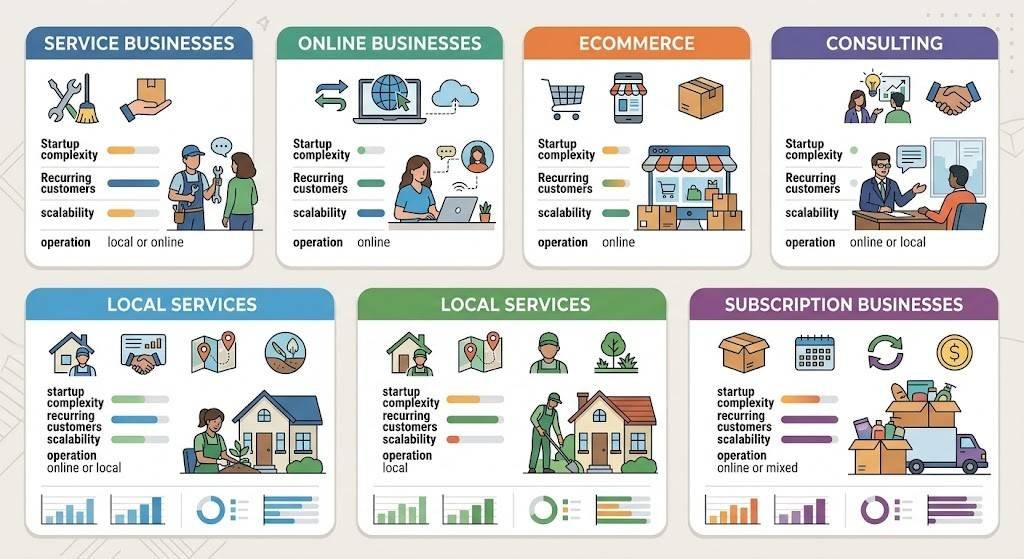
What Makes a Small Business Successful?
Before choosing an idea, it helps to understand what successful businesses tend to have in common.
Strong Customer Demand
A business needs customers who have a problem, need, desire, or job they are willing to pay to solve.
Demand can come from convenience, necessity, specialization, quality, expertise, speed, or a better customer experience.
A good idea therefore starts with a customer problem rather than simply asking, “What business should I start?”
Healthy Business Economics
Revenue alone does not determine whether a business is financially healthy.
You need to understand:
- Revenue
- Gross margin
- Operating expenses
- Customer acquisition costs
- Labor costs
- Equipment and software costs
- Taxes and insurance
- Transportation and fulfillment
A business that generates sales but requires excessive costs to deliver them may not be attractive.
Repeat Customers
Businesses with recurring customers can sometimes have more predictable revenue than businesses that constantly need to find new buyers.
Examples include:
- Bookkeeping
- Cleaning
- Maintenance
- Consulting retainers
- Social media management
- Software subscriptions
- Membership services
However, recurring revenue still depends on customer satisfaction and retention.
Clear Value Proposition
Customers need a reason to choose your business instead of an alternative.
Your value proposition could be based on:
- Better convenience
- Specialized expertise
- Faster service
- Higher quality
- Better communication
- Local availability
- A specific niche
- A simpler buying experience
Manageable Startup Costs
A business does not necessarily need a large investment to become sustainable.
Service businesses, consulting, freelancing, and certain online models can sometimes be tested with fewer resources than inventory-heavy businesses.
But low startup cost does not automatically mean low risk.
Ability to Adapt
Customer expectations, technology, competitors, and markets change.
Businesses that monitor feedback and adjust their products, services, pricing, and marketing can be better positioned to respond to changing conditions.
Effective Marketing
Even a strong product or service needs a way to reach potential customers.
Depending on the business, customer acquisition may involve:
- Search engines
- Local SEO
- Social media
- Referrals
- Email marketing
- Partnerships
- Paid advertising
- Direct outreach
- Marketplaces
- Networking
Operational Discipline
Growth becomes difficult when everyday operations are poorly managed.
Important areas include:
- Financial tracking
- Scheduling
- Customer service
- Quality control
- Inventory management
- Documentation
- Follow-up
- Time management
Scalability
Some businesses can increase capacity through employees, contractors, technology, systems, products, subscriptions, or geographic expansion.
Others remain closely tied to the owner’s time.
Neither model is automatically better. The right choice depends on whether you want a lifestyle business, a specialized practice, or a company designed for larger-scale growth.
25 Most Successful Small Business Ideas Worth Considering
The following businesses are not ranked from “best” to “worst.” Their potential varies according to market conditions, competition, customer demand, skills, costs, and execution.
1. Accounting and Bookkeeping Services
Accounting and bookkeeping businesses help small companies organize financial records, track transactions, prepare reports, and maintain better financial visibility.
Why it may have potential
Businesses need accurate financial records to understand their operations and meet applicable reporting and tax obligations.
Typical customers
- Small businesses
- Freelancers
- Contractors
- Professional firms
- Online businesses
- Local service companies
Skills required
Strong bookkeeping knowledge, attention to detail, financial software familiarity, and reliability are important.
Startup considerations
A home office, computer, accounting software, secure file management, and appropriate professional setup may be sufficient for some business models.
Advantages
Recurring monthly clients can create a service model based on ongoing relationships.
Challenges
Accuracy, confidentiality, deadlines, and applicable professional requirements must be taken seriously.
Revenue model
Common models include monthly packages, project-based bookkeeping, cleanup work, and ongoing financial support.
Customer acquisition
Referrals, local networking, partnerships with professionals, search visibility, and targeted outreach can work well.
Scalability
An individual practice can potentially grow through standardized packages, employees, or an accounting/bookkeeping agency model.
2. Digital Marketing Services
Digital marketing businesses help companies attract and communicate with customers through online channels.
Services may include:
- SEO
- Social media management
- Content marketing
- Email marketing
- Paid advertising
- Conversion optimization
Why it may have potential
Many businesses need online visibility but do not have the expertise or resources to manage every marketing function internally.
Typical customers
Local businesses, ecommerce companies, professional services, startups, and established small businesses.
Skills required
Marketing strategy, analytics, content, communication, and platform-specific knowledge.
Main challenge
Marketing results depend on competition, budget, strategy, execution, industry, and the quality of the offer. Avoid promising guaranteed rankings, leads, or revenue.
Revenue model
You can use project pricing, monthly retainers, campaign fees, or specialized service packages.
Scalability
A solo consultant can eventually develop systems, hire specialists, or build an agency.
3. Web Design and Development
Web design businesses create and maintain websites for businesses, organizations, professionals, and entrepreneurs.
Services can include:
- Business websites
- Ecommerce websites
- Landing pages
- Website redesigns
- Maintenance
- Technical support
Why it may have potential
A professional website can be an important part of a company’s online presence.
Typical customers
Small businesses, professional services, ecommerce sellers, restaurants, local companies, and creators.
Skills required
Web design, UX, content structure, WordPress or development skills, and basic technical knowledge.
Advantages
Projects can be packaged by website type or business niche.
Revenue model
Revenue can come from website projects, maintenance, hosting management, updates, and support.
Scalability
Templates, repeatable processes, specialized packages, and team members can increase capacity.
4. Consulting Services
Consultants monetize specialized knowledge rather than primarily selling physical products.
Possible areas include:
- Business consulting
- Marketing consulting
- Operations consulting
- Technology consulting
- Sales consulting
- Process improvement
Why it may have potential
Businesses may pay for expertise that helps them solve a specific problem more efficiently.
Who it suits
Professionals with substantial practical knowledge in a specific area.
Startup considerations
The main assets are usually expertise, credibility, communication skills, and a clear offer.
Challenge
It can be difficult to differentiate generic consulting. A specific problem, industry, or customer type can make the service easier to position.
Revenue model
Consulting can be project-based, hourly, package-based, or retainer-based.
5. Cleaning Services
Cleaning businesses can serve residential and commercial customers.
Potential niches include:
- Residential cleaning
- Office cleaning
- Deep cleaning
- Move-out cleaning
- Short-term rental cleaning
- Specialized cleaning
Why it may have potential
Cleaning is a clearly defined service, making it relatively straightforward for customers to understand what they are purchasing.
Advantages
Repeat schedules can create ongoing customer relationships.
Challenges
Labor management, scheduling, transportation, supplies, quality control, and customer retention become increasingly important as the business grows.
Revenue model
Customers may pay per visit, per project, or through recurring service agreements.
Scalability
An owner can potentially grow by training employees or contractors and developing standardized procedures.
6. Home and Commercial Maintenance Services
Maintenance businesses can include permitted handyman work, painting, repairs, property maintenance, and related services.
Typical customers
- Homeowners
- Landlords
- Property managers
- Small businesses
- Commercial properties
Why it may have potential
Property owners regularly need maintenance and repairs.
Startup considerations
Tools, transportation, insurance, and appropriate qualifications may be required.
Some construction and trade activities require licenses or permits, so check local requirements before offering regulated services.
Revenue model
Projects, service calls, maintenance agreements, and recurring property contracts can all be possible models.
7. Landscaping and Lawn Care
Landscaping can range from basic lawn maintenance to broader outdoor property services.
Services may include:
- Lawn mowing
- Trimming
- Gardening
- Seasonal cleanup
- Planting
- Commercial landscaping
Why it may have potential
Customers may prefer recurring arrangements rather than handling routine outdoor maintenance themselves.
Challenges
Equipment, transportation, weather, labor, and seasonal demand can affect operating costs.
Scalability
A small operator can gradually add routes, equipment, employees, and commercial clients.
8. Mobile Car Detailing
Mobile car detailing brings cleaning and detailing services directly to customers.
Services can include:
- Interior detailing
- Exterior cleaning
- Waxing
- Polishing
- Specialized detailing packages
Typical customers
Private vehicle owners, professionals, businesses, and fleets.
Advantages
A mobile model can reduce the need for a traditional customer-facing shop.
Startup considerations
Equipment, water requirements, transportation, supplies, insurance, and local rules should be considered.
Customer acquisition
Local SEO, referrals, social media, partnerships with businesses, and fleet outreach can help generate customers.
9. Freelance Writing and Content Services
Freelance writers create content for businesses, websites, publications, ecommerce stores, and other organizations.
Services can include:
- Blog content
- Website copy
- Product descriptions
- Email content
- Editing
- Research-based content
Why it may have potential
Businesses regularly need written material for communication and marketing.
Competitive advantage
Specialization can help. A writer with expertise in a particular industry can develop stronger subject knowledge and more targeted services.
Revenue model
Projects, article packages, monthly content retainers, and editing services are possible.
Scalability
A writing business can evolve into a content agency by adding writers and editors.
10. Graphic Design Services
Graphic designers help businesses communicate visually.
Services may include:
- Branding
- Social media graphics
- Presentations
- Brochures
- Packaging
- Advertisements
Who it suits
Creative professionals with strong design skills and an understanding of business communication.
Customer acquisition
Portfolio websites, social media, referrals, freelance platforms, networking, and direct outreach can all be useful.
Revenue model
Design projects, monthly packages, branding projects, and ongoing creative support.
Challenge
Design markets can be competitive, so specialization and a strong portfolio can be valuable.
11. Video Production and Editing
Businesses and creators increasingly use video for education, marketing, entertainment, and communication.
Services can include:
- Business videos
- YouTube editing
- Short-form video
- Product videos
- Tutorials
- Social media content
Skills required
Video editing, storytelling, audio, visual composition, and platform knowledge.
Startup considerations
A capable computer, editing software, storage, and potentially cameras or audio equipment may be required.
Revenue model
Per-video projects, monthly packages, production services, or editing retainers.
Scalability
Editors can build teams, standardize workflows, or specialize in specific video formats.
12. Online Education and Tutoring
Tutoring and online education businesses can focus on academic subjects, languages, professional skills, or test preparation.
Why it may have potential
Customers often seek help when they need to understand a subject, prepare for an assessment, or develop a practical skill.
Typical customers
Students, parents, professionals, and adult learners.
Skills required
Subject knowledge, communication, teaching ability, and patience.
Startup considerations
A computer, reliable internet connection, teaching materials, and video-conferencing tools may be enough for some online models.
Revenue model
One-to-one sessions, group classes, courses, packages, and memberships.
Qualifications may be important depending on the subject and service offered.
13. Fitness and Wellness Services
Fitness businesses can include:
- Personal training
- Online coaching
- Group classes
- Fitness education
Why it may have potential
People may pay for structured guidance, accountability, and personalized instruction.
Important considerations
Qualifications, insurance, health-related boundaries, and local regulations can apply.
Fitness professionals should avoid making medical claims unless appropriately qualified.
Revenue model
One-to-one sessions, packages, group programs, memberships, or online coaching.
Scalability
Digital programs, group classes, and trained staff can potentially increase capacity.
14. Pet Care Services
Pet-care businesses can include:
- Dog walking
- Pet sitting
- Pet transportation
- Grooming where appropriately qualified
Typical customers
Pet owners who need reliable assistance while working, traveling, or managing busy schedules.
Key requirement
Trust is central to this business. Customers are giving someone responsibility for an important part of their household.
Customer acquisition
Local search, referrals, neighborhood groups, partnerships, and repeat customers can be valuable.
Revenue model
Per-visit pricing, packages, recurring walking schedules, boarding, or specialized services.
15. Home-Based Food Business
Food businesses can include:
- Bakeries
- Specialty foods
- Meal preparation
- Catering
- Custom food products
Why it may have potential
Food can solve both everyday convenience needs and special-event requirements.
Important challenges
Food businesses can involve permits, inspections, food-safety rules, labeling requirements, kitchen requirements, zoning restrictions, and other regulations.
Before selling food, research the rules that apply to your location and specific products.
Revenue model
Individual orders, catering packages, recurring meal services, event orders, and specialty products.
Scalability
Growth may require commercial kitchen capacity, employees, better production systems, or additional delivery and fulfillment capabilities.
16. Ecommerce Business
An ecommerce business sells products through an online store or marketplace.
Possible models include:
- Niche products
- Direct-to-consumer brands
- Marketplace selling
- Specialty stores
Why it may have potential
Online stores can reach customers beyond a local geographic area.
Important considerations
You need to understand:
- Inventory
- Fulfillment
- Shipping
- Returns
- Customer service
- Marketing
- Product margins
Challenge
Generating sales is only one part of the model. Inventory and fulfillment costs can significantly affect the economics.
Scalability
Successful product systems can potentially expand into additional products, markets, channels, or locations.
17. Online Reselling
Reselling involves sourcing products through legitimate channels and selling them at a price that accounts for costs and desired margin.
Key activities
- Product sourcing
- Listing
- Pricing
- Customer service
- Shipping
- Returns
Why it may suit some entrepreneurs
It can be tested on a relatively small scale before expanding.
Challenges
Competition, platform fees, sourcing quality, inventory risk, returns, and price changes can affect results.
Customer acquisition
Marketplaces, social media, search traffic, and repeat customers can all contribute.
18. Digital Products
Digital products include:
- Templates
- Guides
- Checklists
- Spreadsheets
- Planners
- Educational resources
- Design assets
Why it may have potential
Digital products can be delivered electronically without physical inventory or shipping.
Important limitation
Creating a product once does not guarantee sales. The product still needs to solve a real problem and reach the right audience.
Revenue model
Individual purchases, bundles, memberships, licensing, or course-related products.
Scalability
Digital delivery can make additional sales easier to fulfill, although marketing and customer support still require work.
19. Software or Micro-SaaS Business
Micro-SaaS refers to a small software product designed to solve a specific problem, often using a subscription model.
Examples might include software for:
- Scheduling
- Reporting
- Workflow management
- Customer communication
- Industry-specific tasks
Why it may have potential
A focused software product can solve a narrow problem for a defined customer group.
Revenue model
Subscriptions are a common model, although one-time purchases or usage-based pricing may also be possible.
Challenges
Product development, technical maintenance, cybersecurity, customer support, competition, and customer acquisition can all be significant.
Scalability
Software can potentially serve additional customers without increasing delivery labor at the same rate as a traditional service business.
20. Virtual Assistant Agency
Virtual assistants provide remote administrative and operational support.
Services may include:
- Scheduling
- Email management
- Research
- Customer support
- Data organization
- Content management
- Ecommerce administration
Why it may have potential
Small businesses may need support without hiring a full-time internal employee.
Starting model
An entrepreneur can begin independently with a focused service.
Scaling model
As demand increases, the business can potentially add trained assistants and move toward an agency structure.
Challenge
Quality control and communication become increasingly important when multiple team members serve clients.
21. Translation and Language Services
Translation businesses help companies and individuals communicate across languages.
Services can include:
- Translation
- Localization
- Business content
- Website translation
- Interpretation where qualified
Skills required
Strong language ability, cultural understanding, accuracy, and subject knowledge.
Specialization
Legal, technical, financial, medical, and other specialized content may require appropriate expertise and qualifications.
Revenue model
Per-word, per-project, hourly, or ongoing business arrangements may be possible.
22. Photography Services
Photography businesses can specialize in:
- Events
- Portraits
- Products
- Real estate
- Business branding
Why it may have potential
Businesses and individuals need visual assets for marketing, documentation, events, and personal use.
Startup considerations
Equipment, editing software, storage, transportation, insurance, and portfolio development.
Customer acquisition
Local search, referrals, partnerships, social media, networking, and a strong portfolio can help.
Scalability
Photographers can add editing services, assistants, second photographers, video, or specialized packages.
23. Event Planning
Event planners coordinate:
- Venues
- Vendors
- Schedules
- Budgets
- Decorations
- Logistics
- Guest-related details
Potential niches include weddings, corporate events, private celebrations, and community events.
Skills required
Organization, communication, negotiation, scheduling, problem-solving, and vendor management.
Revenue model
Planning fees, packages, coordination fees, or event management contracts.
Challenge
Events involve deadlines and multiple stakeholders, so reliability and organization are critical.
24. Senior Support and Non-Medical Assistance
A non-medical senior-support business can provide services such as:
- Errands
- Companionship
- Shopping assistance
- Transportation coordination
- Household assistance
This should be clearly distinguished from healthcare or medical services.
Important considerations
Local requirements, insurance, background checks, transportation rules, and service boundaries may apply.
Why it may have potential
Families may value trustworthy help with practical everyday tasks.
Revenue model
Hourly services, scheduled visits, recurring packages, or coordination services.
25. Specialized Local Services
Some of the strongest opportunities are not broad business categories but narrow solutions to local problems.
Examples include:
- Moving assistance
- Mobile services
- Equipment rental
- Specialized cleaning
- Local business support
- Property services
How to find the opportunity
Look for situations where:
- Customers have a recurring problem.
- Existing providers are difficult to reach.
- Service quality is inconsistent.
- Customers value convenience.
- Competitors serve a broad market but ignore a niche.
- You can deliver the service efficiently.
The opportunity is not simply “start a local service.” It is to identify an underserved need and build an offer around it.
Most Successful Low-Cost Business Ideas
“Low-cost” depends on what resources you already have.
For one entrepreneur, a laptop and existing skills may be enough to test a service. Another person may need equipment, transportation, insurance, software, or professional qualifications.
Potential low-overhead models include:
- Freelancing
- Consulting
- Virtual assistance
- Tutoring
- Writing
- Graphic design
- SEO
- Translation
- Digital products
Service businesses can sometimes be tested before purchasing significant inventory, which can reduce initial financial exposure.
However, low startup cost does not mean low risk. Time, customer acquisition, software, taxes, insurance, and professional expenses still matter.
Most Successful Home-Based Business Models
A home-based business can potentially reduce the need for commercial space, depending on the activity and local rules.
Examples include:
- Freelancing
- Consulting
- Virtual assistance
- Online tutoring
- Digital products
- Web design
- SEO
- Graphic design
- Ecommerce
- Content creation
A home-based model can be especially useful when the business primarily depends on skills, knowledge, software, or digital delivery.
Food production, customer visits, inventory storage, and other activities may be subject to zoning, licensing, safety, or building requirements.
For a broader look at home-based opportunities, you can later add your published home-based business ideas article here once that supporting page is live.
Online Business Models With Growth Potential
Service-Based Online Businesses
Examples include:
- SEO
- Web design
- Writing
- Graphic design
- Consulting
- Virtual assistance
These models generally sell expertise or labor rather than physical products.
Product-Based Online Businesses
Examples include:
- Ecommerce
- Reselling
- Handmade products
- Niche product brands
These businesses require greater attention to inventory, fulfillment, shipping, returns, and customer service.
Digital Product Businesses
Examples include:
- Templates
- Courses
- Guides
- Checklists
- Educational resources
Digital products can simplify fulfillment but still require useful content and effective distribution.
Subscription Businesses
Examples include:
- SaaS
- Memberships
- Recurring services
- Subscription products
Subscription models can create recurring revenue, but retention is essential. Customers will continue paying only when they continue receiving value.
Service Businesses vs. Product Businesses
| Factor | Service Business | Product Business |
| Inventory | Usually lower | Often required |
| Startup needs | Can be lower | Can be higher |
| Delivery | Time/skill based | Physical or digital product |
| Scalability | Often requires staff or systems | Can scale through products |
| Customer relationship | Often direct | May be less personal |
| Main risks | Time capacity | Inventory and fulfillment |
Neither model is automatically better.
A service business may be easier to test but can become limited by the owner’s time. A product business may scale through inventory and systems but can involve greater upfront costs and operational complexity.
Businesses With Recurring Revenue Potential
Recurring revenue means customers pay repeatedly instead of making only one purchase.
Examples include:
- Cleaning contracts
- Maintenance services
- Bookkeeping
- Software subscriptions
- Memberships
- Retainer-based consulting
- Social media management
Recurring customers can make revenue more predictable, but retention is never automatic.
A recurring model requires consistent service quality, clear communication, useful results, and a reason for customers to continue.
How to Identify a High-Demand Business Opportunity
Instead of assuming an idea will work, test the market.
Step 1: Identify a Customer Problem
Start with a specific problem people already experience.
Step 2: Determine Who Experiences It
Define the customer clearly.
For example, “businesses” is broad. “Independent real estate agents who need property video editing” is much more specific.
Step 3: Research Existing Solutions
Find out how customers currently solve the problem.
Step 4: Study Competitors
Look at:
- Pricing
- Services
- Reviews
- Positioning
- Customer complaints
- Service areas
- Delivery methods
Step 5: Look for Gaps
You may find opportunities around convenience, specialization, speed, communication, pricing structure, or service quality.
Step 6: Test Willingness to Pay
Ask potential customers whether they would actually pay for the proposed solution.
Step 7: Calculate Costs
Estimate:
- Labor
- Equipment
- Software
- Marketing
- Transportation
- Insurance
- Taxes
- Materials
Step 8: Test the Offer
Create a simple version of the service or product.
Step 9: Measure Customer Response
Track inquiries, conversations, sales, repeat purchases, and objections.
Step 10: Improve the Model
Use real customer feedback to improve pricing, positioning, delivery, and the offer itself.
How to Choose the Most Suitable Business for You
The “most successful” business in the market may not be the best choice for you.
Compare opportunities based on:
Skills
What can you already do well?
Experience
Do you understand the industry or customer?
Budget
How much can you afford to invest without creating unnecessary financial pressure?
Time
Can you operate the business alongside your existing responsibilities?
Location
Does the business depend on local customers, transportation, regulations, or physical premises?
Customer Demand
Is there evidence that people need the product or service?
Competition
Can you realistically differentiate yourself?
Risk Tolerance
Are you comfortable with inventory, employees, equipment, or recurring expenses?
Growth Goals
Do you want a flexible solo business or something designed to become a larger company?
Lifestyle Preferences
A business should fit the life you actually want to build.
How to Evaluate Profit Potential
One of the most important principles in entrepreneurship is simple:
Revenue is not the same as profit.
A basic revenue model can be expressed as:
Revenue = Customers × Average Transaction Value × Purchase Frequency
But revenue is only the starting point.
Expenses may include:
- Startup costs
- Fixed costs
- Variable costs
- Marketing
- Labor
- Software
- Transportation
- Taxes
- Insurance
- Materials
- Payment processing
- Professional services
A business charging $500 for a service is not automatically profitable. You need to know how much time, labor, marketing, software, transportation, and other expenses are required to generate and deliver that sale.
You should also understand gross margin and operating expenses.
The goal is not simply to increase sales. It is to build a model where the economics remain sensible after the costs required to acquire and serve customers.
Market Research Before Starting
Market research can help you understand:
- Target customers
- Local demand
- Online demand
- Competitors
- Customer pain points
- Existing pricing
- Market trends
- Geographic differences
- Existing alternatives
For U.S.-focused research, the Census Bureau small business data can provide useful official data for understanding business activity and the broader small-business environment.
Research should also happen at the customer level.
Ask:
- Who buys this?
- Why do they buy it?
- How often do they need it?
- What alternatives exist?
- What are competitors offering?
- What frustrates customers about current options?
- Why would someone choose a new provider?
Startup Costs and Financial Planning
Startup costs vary significantly by business model.
One-Time Costs
Potential examples include:
- Equipment
- Website
- Initial branding
- Registration
- Inventory
- Tools
- Professional setup
Recurring Costs
These may include:
- Software
- Rent
- Insurance
- Advertising
- Supplies
- Transportation
- Professional services
- Employee or contractor costs
Before spending heavily, create a realistic budget.
The SBA business planning resources can help U.S. entrepreneurs think through business planning, market research, and startup-cost considerations.
Avoid purchasing equipment, inventory, office space, or software simply because it makes the business look more professional.
First determine what is actually required to serve your first customers.
Legal, Tax, and Business Requirements
Business requirements vary by location and business type.
Potential considerations include:
- Business registration
- Business structure
- Licenses
- Permits
- Insurance
- Taxes
- Record keeping
- Business banking
- Zoning
- Food-safety requirements
- Professional qualifications
For U.S. entrepreneurs, the IRS small business guidance provides official information for small businesses and self-employed individuals.
You can also review IRS business tax information for tax-related guidance.
These are U.S.-specific government resources. If you operate elsewhere, use the official tax and business authorities for your own jurisdiction.
Common Reasons Small Businesses Struggle
There is no single reason businesses struggle. Common problems can include:
Weak Demand
A business cannot compensate for a product or service that customers do not actually want.
Poor Pricing
Prices need to account for delivery costs, time, overhead, and the value provided.
High Operating Costs
Unnecessary expenses can make an otherwise promising business difficult to sustain.
Lack of Differentiation
If customers cannot understand why they should choose you, competing on price may become the default.
Poor Cash-Flow Management
A profitable-looking business can still experience financial pressure if cash arrives later than expenses are due.
Weak Customer Service
Poor communication can damage repeat business and referrals.
Inconsistent Marketing
Businesses need a reliable way to reach potential customers.
Scaling Too Quickly
Hiring, inventory, equipment, or expansion before the economics are proven can increase risk.
Ignoring Feedback
Customer complaints and questions can reveal opportunities to improve the offer.
Failing to Adapt
Markets change. A business that refuses to adjust may lose relevance.
30-Day Plan to Test a Business Idea
You do not need to build everything before learning whether your idea has potential.
Days 1–7: Research
Focus on:
- Customer
- Problem
- Competition
- Demand
- Existing alternatives
Speak with potential customers if possible.
Days 8–14: Create
Develop:
- Basic offer
- Pricing
- Simple landing page or profile
- Customer outreach plan
- Basic delivery process
Avoid unnecessary spending.
Days 15–21: Test
Start contacting prospects.
Try to:
- Generate inquiries
- Offer a pilot
- Collect feedback
- Test pricing
- Track objections
- Attempt initial sales
Days 22–30: Review
Look at:
- Customer response
- Revenue
- Costs
- Feedback
- Delivery time
- Customer objections
- Repeat interest
Then decide whether to improve, narrow, change, or continue with the idea.
How to Scale a Successful Small Business
Once the basic economics are working, growth can come from several directions.
Increase Customers
Improve marketing, referrals, partnerships, local visibility, or online acquisition.
Increase Average Order Value
Offer relevant upgrades, bundles, complementary products, or additional services.
Increase Repeat Purchases
Improve customer experience and create legitimate reasons for customers to return.
Improve Efficiency
Use systems, templates, automation, scheduling tools, and documented processes.
Hire Employees or Contractors
Increase capacity when additional labor makes financial sense.
Expand Locations
Local businesses may eventually expand into additional service areas.
Add Digital Products
Service businesses can sometimes create guides, templates, courses, or other products based on their expertise.
Build Recurring Revenue
Retainers, subscriptions, memberships, and recurring services can create ongoing customer relationships where appropriate.
Growth should be controlled. More customers do not automatically mean a healthier business if costs increase faster than revenue or service quality declines.
Quick Comparison of Small Business Models
The following is a general comparison, not a guarantee of performance.
| Business | Startup Complexity | Home-Based | Online | Recurring Revenue Potential | Scalability |
| Bookkeeping | Moderate | Yes | Yes | High | Moderate |
| Digital marketing | Moderate | Yes | Yes | High | High |
| Web design | Moderate | Yes | Yes | Moderate | High |
| Consulting | Low–Moderate | Yes | Yes | Moderate–High | Moderate |
| Cleaning | Low–Moderate | Sometimes | No | High | High with staff |
| Landscaping | Moderate | No | No | High | Moderate–High |
| Car detailing | Moderate | No | No | Moderate | Moderate |
| Freelance writing | Low | Yes | Yes | Moderate | Moderate |
| Graphic design | Low–Moderate | Yes | Yes | Moderate | Moderate–High |
| Ecommerce | Moderate–Higher | Yes | Yes | Moderate | High |
| Digital products | Low–Moderate | Yes | Yes | Depends on model | High |
| Micro-SaaS | Higher | Yes | Yes | High | High |
The right model depends on your skills, resources, customers, competition, and preferred way of working.
Which Business Is the “Best” for You?
There is no universal winner among the most successful small business ideas.
A business may be attractive on paper but unsuitable for your situation.
A stronger opportunity usually combines:
- Real customer demand
- Skills you can use effectively
- Affordable startup requirements
- Sustainable operating costs
- A realistic customer-acquisition strategy
- A good personal fit
- A clear value proposition
- An opportunity to improve over time
Instead of asking only, “Which business is most profitable?”
Ask:
“Which business can I realistically build, operate, and improve for the customers I want to serve?”
That question leads to better decisions because it considers both the market and the entrepreneur.
Conclusion
The most successful small business ideas are not necessarily the newest, cheapest, or most popular opportunities.
Successful businesses generally solve meaningful customer problems while maintaining sensible economics.
Some models, such as bookkeeping, cleaning, maintenance, consulting, and recurring marketing services, can benefit from repeat customers. Others, such as ecommerce, digital products, and software, may offer different paths to scalability. Home-based and low-overhead businesses can reduce certain costs, but they still require effective marketing, customer service, financial discipline, and execution.
Before making a major investment, research the market, study competitors, calculate realistic costs, test the offer, and listen to potential customers.
The best opportunity is usually not the one that sounds impressive. It is the one where customer demand, business economics, your skills, resources, and long-term goals fit together.
Frequently Asked Questions
What are the most successful small business ideas?
There is no single business that is guaranteed to succeed. Strong opportunities can include service businesses, consulting, bookkeeping, digital marketing, cleaning, specialized local services, ecommerce, digital products, and software. The right choice depends on demand, competition, pricing, operating costs, skills, and execution.
What is the most profitable small business to start?
Profitability varies by business model and market. A business with high revenue may still produce limited profit if labor, marketing, inventory, equipment, or other operating costs are high.
Instead of looking for one guaranteed winner, compare customer demand, pricing, delivery costs, customer acquisition costs, and potential for repeat business.
What are the best successful businesses to start with little money?
Low-overhead service businesses can be easier to test with limited resources. Examples include freelancing, consulting, tutoring, writing, virtual assistance, translation, SEO, and certain digital-product businesses.
However, low startup cost does not mean low risk.
Can a home-based business become successful?
Yes, some home-based businesses can grow substantially, depending on the business model and market.
Freelancing, consulting, web design, digital marketing, ecommerce, tutoring, digital products, and other models can potentially be operated from home.
Growth may eventually require employees, equipment, commercial space, or other resources.
What makes a small business successful?
Important factors include real customer demand, a clear value proposition, sensible pricing, manageable costs, effective marketing, strong customer service, financial tracking, and the ability to adapt.
Execution matters as much as the original idea.
How do I know whether a business idea has potential?
Research the customer problem, study competitors, identify existing alternatives, test willingness to pay, calculate costs, and run a small pilot.
Real customer behavior is generally more useful than assumptions.
Should I choose a business because it is trending?
Not necessarily.
Trends can create opportunities, but they can also attract significant competition.
Before following a trend, investigate whether the demand is sustainable, who the customers are, what competitors offer, how much it costs to operate, and whether the opportunity fits your skills and resources.
admin
Practical business guides, useful tools, and technology insights from BusinessNexa.



Work smarter with practical business tools.
Explore useful calculators, guides and tools for modern businesses.