
Small Business Ideas 2026: 25+ Opportunities to Consider This Year
Starting a business in 2026 does not necessarily mean building a large company, renting an expensive office, or developing a […]


Starting a business in 2026 does not necessarily mean building a large company, renting an expensive office, or developing a complicated product from day one.
For some entrepreneurs, the right opportunity may be a specialized service business. For others, it could be an online business, a home-based operation, a local service, an ecommerce store, a digital product, or a technology-focused business.
The challenge is not simply finding a list of small business ideas 2026. The more important question is whether an idea fits your skills, budget, available time, target customers, location, competition, and ability to acquire customers.
This guide explores 28 business opportunities you can consider in 2026, including online services, local businesses, technology opportunities, AI-assisted services, creative businesses, professional services, and product-based models.
The goal is not to predict which business will become the next big thing. Instead, it is to help you evaluate opportunities realistically, test demand, and decide which business model makes sense for your situation.
If you want a broader starting point, explore our complete guide to small business ideas.
What Makes a Good Small Business Idea in 2026?
A business idea does not become attractive simply because it is new or trending.
A stronger opportunity usually has several characteristics that make it easier to evaluate and operate.
It Solves a Real Problem
Customers generally pay for products and services because they solve a problem, save time, provide convenience, improve an outcome, or satisfy a specific need.
Before choosing an idea, ask:
What problem does this business solve, and who experiences that problem?
The clearer the answer, the easier it may be to develop an offer and explain it to customers.
It Has a Clear Target Customer
Trying to sell to everyone can make marketing difficult.
A business serving independent restaurants, for example, may have a clearer positioning if it specializes in restaurant websites, local SEO, or social media management rather than simply advertising itself as a general digital agency.
Startup Requirements Are Reasonable
The right business should fit your available resources.
A service business may require a computer, software, internet access, and relevant skills, while an ecommerce or food business may require inventory, equipment, storage, packaging, permits, or additional operating resources.
Demand Can Be Tested
You should be able to test whether potential customers actually care about your offer before making a major investment.
Customer conversations, competitor research, pilot services, small product launches, pre-orders where appropriate, and direct outreach can all provide useful evidence.
Competition Is Manageable
Competition is not automatically a bad sign.
In many cases, existing competitors demonstrate that customers already understand the category. The important question is whether you can serve a particular customer group, solve a specific problem, improve convenience, or offer a differentiated experience.
The Business Model Makes Sense
Consider how the business will actually make money.
Will you sell one-time projects, products, subscriptions, appointments, retainers, memberships, or a combination?
A good idea needs a practical path from customer problem to offer to payment.
Customers Can Potentially Return
Some businesses naturally involve repeat purchases or ongoing services.
Examples include cleaning, maintenance, bookkeeping, consulting retainers, pet care, subscriptions, and recurring digital services.
Repeat business is never guaranteed, but understanding customer retention can be useful when evaluating an opportunity.
The Business Can Adapt
Customer expectations, technology, competition, and operating costs can change.
A business that can adjust its services, delivery methods, customer segments, or technology may be better positioned to respond to changing conditions.
Technology Is Used Where It Adds Value
Technology can reduce repetitive work, improve communication, organize information, or make services easier to deliver.
However, technology should support the business rather than become the business strategy itself.
28 Small Business Ideas to Consider in 2026
The following ideas cover different business models and skill levels. Some can be started remotely, while others depend heavily on local demand.
None is guaranteed to succeed. Actual results depend on customer demand, competition, pricing, operating costs, execution, and the entrepreneur’s ability to acquire and retain customers.
1. AI-Assisted Business Services
AI-assisted services are an emerging opportunity for people who understand both business problems and modern AI tools.
Potential services include:
- AI workflow setup
- Research assistance
- Content support
- Document organization
- Customer-service workflow design
- Data and information processing
- Basic business automation
- AI tool implementation support
The opportunity is not simply selling access to an AI tool. Businesses may need help identifying repetitive processes and deciding where technology can actually save time or improve operations.
Human judgment remains important for reviewing outputs, protecting sensitive information, checking accuracy, and adapting workflows to a particular business.
A practical starting point is to choose one business problem rather than offering vague “AI services.”
2. Digital Marketing Services
Digital marketing remains a broad service category that can include:
- SEO
- Local SEO
- Social media marketing
- Content marketing
- Email marketing
- Paid advertising support
- Conversion-focused website improvements
A small agency or freelancer can specialize in one service or one customer segment.
For example, instead of targeting every business, a provider might focus on helping local professional services improve their online visibility.
The major challenge is demonstrating useful business value without making unrealistic promises about rankings, traffic, leads, or sales.
3. Local SEO Services
Local SEO focuses on helping businesses improve their visibility when customers search for services in a particular geographic area.
Potential work can include:
- Google Business Profile optimization
- Local content
- Review management processes
- Local citations
- Location-focused pages
- Website optimization
This model can suit someone who understands search engines, local businesses, content, and basic website optimization.
However, local SEO results depend on many factors, including competition, website quality, relevance, location, reviews, and search-engine systems. No responsible provider should guarantee a specific ranking.
4. Virtual Assistant Services
Virtual assistants provide administrative and operational support remotely.
Services may include:
- Email management
- Scheduling
- Research
- Data organization
- Customer communication
- Document preparation
- Calendar management
- Basic content administration
This can be a practical option for organized people who are comfortable with digital tools.
A virtual assistant can start with general support and later specialize in areas such as ecommerce administration, real estate support, podcast management, or customer operations.
5. Web Design and Website Services
Businesses of all sizes may need websites, landing pages, ecommerce stores, redesigns, maintenance, or ongoing website support.
Potential services include:
- Business websites
- Ecommerce websites
- Landing pages
- Website redesigns
- Website maintenance
- Performance and usability improvements
A focused service can be easier to market than a broad “we build everything” offer.
Recurring work may come from maintenance, updates, content changes, or ongoing website support.
6. Online Tutoring
Online tutoring can cover academic subjects, languages, test preparation, software, professional skills, and other areas where the tutor has appropriate knowledge.
A focused subject can make positioning clearer.
For example, a tutor could specialize in a particular school subject, language level, examination, or professional skill.
Customer acquisition may come through referrals, educational communities, content, local outreach, and tutoring platforms.
7. Online Consulting
Consulting allows professionals to sell specialized knowledge.
Possible areas include:
- Marketing
- Business operations
- Career development
- Technology
- Human resources
- Customer service
- Industry-specific expertise
The most important requirement is genuine expertise.
Consultants should clearly define the problem they solve, who they serve, and what customers receive.
Some professional consulting areas may also have licensing or qualification requirements, so check applicable rules before offering regulated services.
8. Bookkeeping and Accounting Support
Bookkeeping businesses can provide services such as:
- Transaction organization
- Expense tracking
- Reconciliation
- Record management
- Basic financial reporting
This can be attractive because many businesses need ongoing financial record organization.
However, requirements vary by jurisdiction and by the exact service being offered. Some accounting activities may require professional qualifications or authorization.
The safest approach is to clearly define your services and verify applicable rules before taking clients.
9. Content Writing and Editing
Writing businesses can provide:
- Blog articles
- Website content
- Copyediting
- Technical writing
- Business documentation
- Product descriptions
- Newsletters
A writer can differentiate by developing expertise in a particular industry or content type.
Recurring customers may be possible when businesses need ongoing content or editing support, although client retention depends on service quality and customer needs.
10. Video Editing and Content Production
Video continues to be an important format for businesses, educators, creators, and publishers.
Services may include:
- YouTube editing
- Short-form videos
- Social media clips
- Captions
- Product videos
- Business videos
- Content repurposing
This can often be delivered remotely.
A specialist may find it easier to market a specific service, such as editing short-form business content, rather than offering every possible type of video production.
11. Graphic Design
Graphic design businesses can create:
- Brand assets
- Social media graphics
- Presentations
- Marketing materials
- Packaging designs
- Digital products
A strong portfolio and clear specialization can help demonstrate value.
Designers may work with local businesses, agencies, ecommerce sellers, publishers, creators, or other organizations.
12. Online Reselling
Online reselling involves sourcing products and selling them through marketplaces, websites, or other appropriate channels.
Potential niches include:
- Used goods
- Collectibles
- Specialty products
- Niche consumer products
The business requires more than finding products cheaply.
You need to understand sourcing, demand, fees, shipping, returns, pricing, product condition, and competition.
A small test can help determine whether a product category deserves additional investment.
13. Niche Ecommerce Store
Instead of trying to sell everything, a niche ecommerce store can focus on a specific customer group or product category.
Before purchasing substantial inventory, investigate:
- Customer demand
- Competitors
- Product costs
- Shipping
- Returns
- Packaging
- Platform fees
- Customer acquisition
Ecommerce can potentially scale, but it also involves inventory and operational responsibilities that service businesses may not have.
14. Digital Products
Digital products can include:
- Templates
- Checklists
- Guides
- Spreadsheets
- Planners
- Educational resources
- Design assets
The advantage is that a digital product does not need to be physically manufactured for every customer.
However, creating the product is only part of the business.
You still need to identify a useful problem, create something customers value, build trust, choose a distribution method, and market the product.
15. Online Courses and Education
People with genuine expertise can package their knowledge into structured educational products.
Possible subjects include:
- Professional skills
- Software
- Languages
- Creative skills
- Business
- Practical hobbies
A good course should solve a specific problem for a defined audience.
Course creation can potentially scale, but audience building, customer support, updates, and marketing still require ongoing work.
16. Cleaning Services
Cleaning businesses can serve:
- Homes
- Offices
- Rental properties
- Commercial spaces
- Specialized environments
Potential specialties include deep cleaning, move-out cleaning, residential cleaning, or commercial cleaning.
The business requires planning around equipment, transportation, supplies, scheduling, insurance, pricing, and customer acquisition.
Recurring arrangements may be possible when customers need regular service.
17. Mobile Car Detailing
Mobile detailing brings cleaning and vehicle-care services directly to customers.
The model can appeal to people who prefer local, hands-on work and may value convenience.
Important considerations include:
- Equipment
- Transportation
- Water and power requirements
- Service area
- Pricing
- Weather
- Local competition
A small geographic service area can make operations easier to manage initially.
18. Home Maintenance Services
Home maintenance businesses can cover services such as:
- Minor repairs
- Painting
- Pressure washing
- Maintenance support
- Property upkeep
The exact services should match the operator’s skills and local regulations.
Certain construction, electrical, plumbing, or specialized work may require licenses or permits.
A clear service area and defined list of services can make customer communication easier.
19. Landscaping and Lawn Services
Landscaping and lawn care can be suitable for entrepreneurs who prefer outdoor, local work.
Potential services include:
- Lawn maintenance
- Yard cleanup
- Plant care
- Seasonal maintenance
- Basic landscaping
Equipment requirements, transportation, seasonality, weather, and competition all affect the business model.
Recurring service arrangements may be possible for customers who need regular maintenance.
20. Pet Care Services
Pet care can include:
- Dog walking
- Pet sitting
- Vacation care
- Pet transportation
- Grooming where appropriately qualified
Trust is central to this type of business.
Providers should consider safety procedures, transportation, insurance, animal-handling knowledge, and applicable local requirements.
Regular walking or repeat pet-care customers can potentially provide ongoing demand.
21. Photography Services
Photography businesses can specialize in:
- Events
- Portraits
- Product photography
- Business photography
- Real estate photography
- Personal branding
Equipment requirements vary significantly by niche.
A strong portfolio can be more useful than offering a long list of unrelated photography services.
Local networking can be valuable for events and portraits, while product and business photography can also be marketed online.
22. Specialty Food Business
Food businesses can include:
- Home bakeries
- Catering
- Meal preparation
- Specialty foods
- Event food services
Food businesses require careful planning because requirements may include permits, food-safety rules, inspections, labeling, zoning restrictions, or approved facilities.
Do not assume that a home kitchen can legally be used for every type of food business. Check the rules applicable to your location and product.
23. Clothing and Alteration Services
Tailoring and clothing services can include:
- Alterations
- Clothing repairs
- Custom garments
- Small-batch clothing
- Personalized items
This model can work well for people with established sewing skills and appropriate equipment.
Unlike product-only businesses, alteration services solve a specific customer problem and can often be delivered locally.
24. Translation and Language Services
Translation businesses can serve:
- Businesses
- Websites
- Agencies
- Publishers
- Individuals
- Organizations
Strong language ability is important, but specialized translation may also require subject knowledge and terminology expertise.
A provider can differentiate by focusing on a particular language pair or industry.
25. Event Planning
Event planners coordinate the many details involved in an event.
Services may include:
- Vendor coordination
- Scheduling
- Budget planning
- Venue coordination
- Decorations
- Guest communication
- Event-day logistics
Potential niches include weddings, corporate events, birthdays, private celebrations, and community events.
The work can be rewarding but deadline-heavy, so organization and communication are essential.
26. Senior Support and Non-Medical Assistance
Non-medical senior support can include:
- Errands
- Companionship
- Transportation coordination
- Household assistance
- Appointment coordination
These services must be clearly distinguished from medical care or regulated healthcare services.
Local requirements, insurance, transportation rules, and background-check expectations may vary.
Trust, reliability, communication, and safety are particularly important in this category.
27. Subscription-Based Services
Some businesses can structure their services around recurring customer needs.
Examples may include:
- Website maintenance
- Cleaning
- Lawn care
- Content services
- Consulting
- Product subscriptions
- Business support
A subscription or recurring arrangement can make revenue more predictable for some businesses, but customers still need a reason to continue paying.
The key is delivering continuing value rather than simply converting a one-time service into a recurring charge.
28. Micro-SaaS and Small Software Products
Micro-SaaS refers to relatively focused software products that solve a narrow problem for a defined customer group.
A technical entrepreneur might build software for:
- Scheduling
- Reporting
- Internal workflows
- Document management
- Industry-specific tasks
- Small business administration
The biggest mistake is building a product before understanding the problem.
Customer interviews, prototypes, landing pages, demonstrations, and early user feedback can help test demand before significant development work.
Best Low-Cost Business Ideas for 2026
Some businesses can be started with fewer physical resources because they primarily depend on skills and time.
Potential options include:
- Freelancing
- Consulting
- Virtual assistance
- Tutoring
- Writing
- Graphic design
- SEO
- Social media management
- Digital products
- Local services
Low-cost does not mean free.
Software, equipment, internet access, registration, insurance, marketing, transportation, and professional services can all create expenses.
If you want to compare more opportunities, see our guide to top small business ideas.
A useful strategy is to start with the smallest realistic version of the business and test demand before making larger purchases.
Best Small Business Ideas You Can Start From Home
Home-based businesses can reduce the need for a separate commercial location, but they are not automatically simple or inexpensive.
Potential options include:
- Freelancing
- Online tutoring
- Consulting
- Ecommerce
- Digital products
- Content creation
- Virtual assistance
- Online courses
- Tailoring
- Certain food businesses where permitted
The practical requirements depend on the business.
A home-based business may still require storage, equipment, software, insurance, permits, zoning approval, or appropriate facilities.
For a deeper look at home-based opportunities, explore our guide to home-based small business ideas.
Online Business Ideas for 2026
Online businesses can reach customers beyond a local service area, but they still require a clear offer and customer-acquisition strategy.
Common models include:
Online Services
Writing, SEO, design, consulting, virtual assistance, web development, and video editing can all be delivered remotely.
Ecommerce
Online stores can sell physical products but require attention to sourcing, inventory, fulfillment, returns, and customer service.
Digital Products
Templates, guides, educational resources, and design assets can be distributed digitally.
Online Education
Tutoring, courses, workshops, and specialized training can serve customers remotely.
Content Businesses
Blogs, newsletters, video channels, podcasts, and educational content can build audiences over time.
Software
Micro-SaaS products can solve specialized problems for defined customer groups.
The important distinction is between building an audience and selling directly to customers. Content businesses may take time to develop an audience, while service businesses can often begin with direct customer outreach.
Most Successful Types of Small Businesses
There is no universal list of businesses that will be the most successful for everyone.
Success depends on factors such as:
- Customer demand
- Competition
- Pricing
- Operating costs
- Customer acquisition
- Retention
- Business owner’s skills
- Location
- Execution
A business can look attractive on paper but perform poorly if the entrepreneur cannot acquire customers or control operating costs.
For a deeper discussion of what can make a business model sustainable, explore our guide to successful small business ideas.
Small Business Ideas Based on Your Skills
One practical way to narrow your choices is to start with skills you already possess.
Writing Skills
Consider:
- Content writing
- Editing
- Copywriting
- Technical writing
Technology Skills
Consider:
- Web design
- Software
- Automation
- Technical support
Marketing Skills
Consider:
- SEO
- Local SEO
- Digital marketing
- Social media management
Teaching Skills
Consider:
- Tutoring
- Courses
- Educational content
Creative Skills
Consider:
- Graphic design
- Photography
- Video editing
- Digital products
Hands-On Skills
Consider:
- Repairs
- Maintenance
- Landscaping
- Detailing
- Tailoring
The goal is not to turn every skill into a business. Look for a skill that solves a customer problem and can be packaged into a clear offer.
How to Choose the Right Business Idea in 2026
Before investing significant money, ask these questions:
1. What skills do you already have?
Existing skills may reduce the learning curve.
2. What problem can you solve?
Describe the customer’s problem in simple language.
3. Who is your customer?
Be specific about the type of person or organization you want to serve.
4. How much can you realistically invest?
Consider both startup expenses and ongoing operating costs.
5. Can you start part-time?
A part-time test can reduce the risk of committing too early.
6. How will you find your first customers?
Think about outreach, referrals, search, marketplaces, partnerships, networking, or content.
7. Who are your competitors?
Study their offers, positioning, pricing structure, customer reviews, and weaknesses.
8. Can customers understand your offer quickly?
If someone cannot understand what you sell or who it is for, marketing becomes harder.
9. Is there enough demand?
Look for evidence rather than relying only on personal assumptions.
10. Can the model grow in a way you actually want?
Growth can mean more customers, higher-value services, additional products, better systems, or simply a stable business that fits your lifestyle.
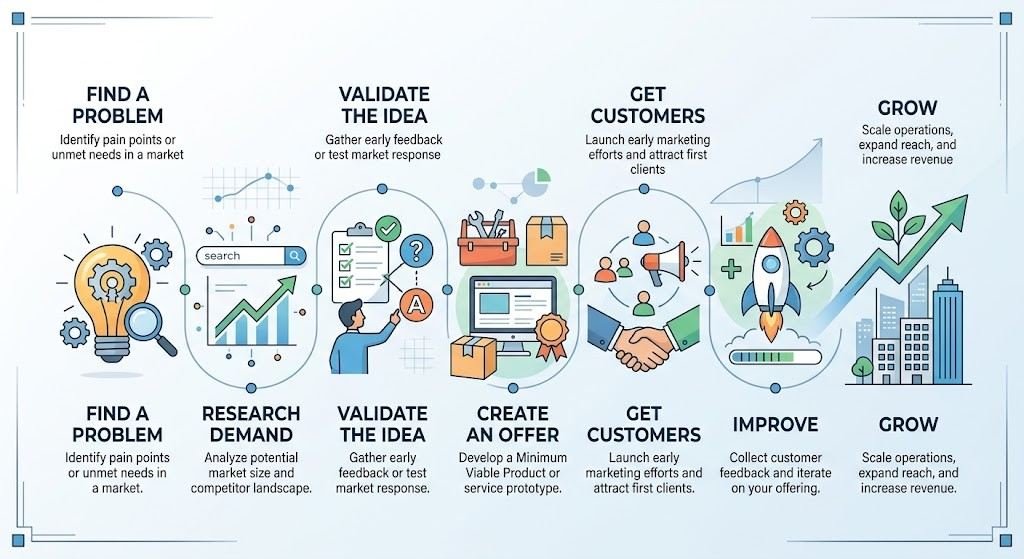
How to Validate a Business Idea Before Investing
Validation is about collecting evidence before making a major commitment.
Step 1: Define the Customer
Identify exactly who you want to serve.
Step 2: Identify the Problem
Understand what customers currently struggle with.
Step 3: Research Competitors
Find businesses already solving the problem.
Step 4: Talk to Potential Customers
Ask about their current solutions, frustrations, priorities, and buying behavior.
Step 5: Create a Simple Offer
Build the smallest practical version of the product or service.
Step 6: Try to Get Initial Customers
Direct customer interest is more useful evidence than compliments.
Step 7: Measure Feedback
Track inquiries, objections, purchases, cancellations, and repeat interest.
Step 8: Improve the Offer
Use feedback to adjust the product, service, pricing, positioning, or customer experience.
Step 9: Decide Whether More Investment Makes Sense
If evidence remains weak, change the model or stop before spending substantially more.
Market Research for a New Business
Good market research does not necessarily require a large research budget.
You can investigate:
- Search demand
- Competitors
- Customer reviews
- Local businesses
- Pricing
- Customer complaints
- Industry developments
- Online communities
- Marketplace listings
- Direct customer feedback
For U.S.-focused research, the U.S. Census Bureau’s small business data can provide official information for understanding small-business activity and related data.
For local businesses, also study the actual service area. A business can face strong national interest but weak demand in one local market.
Startup Costs and Financial Planning
Startup costs differ substantially between business models.
Potential one-time expenses include:
- Equipment
- Website setup
- Initial inventory
- Registration
- Permits
- Branding
- Professional services
Recurring expenses can include:
- Software
- Internet
- Advertising
- Insurance
- Supplies
- Transportation
- Platform fees
- Inventory replenishment
- Professional services
Working capital is also important. A business may need cash to operate while customers are being acquired and before revenue becomes consistent.
For U.S.-based entrepreneurs, the U.S. Small Business Administration’s business-planning guidance covers areas such as market research, business planning, and startup-cost planning.
This is U.S.-specific government guidance and should not be treated as universal advice for other countries.
Legal and Tax Considerations
Business requirements depend on your location, business structure, industry, and the services or products you provide.
Potential considerations include:
- Business registration
- Business structure
- Licenses
- Permits
- Taxes
- Insurance
- Contracts
- Intellectual property
- Record keeping
- Separate business finances
For U.S. readers, the IRS Small Businesses and Self-Employed resource is an official starting point for federal tax information.
The IRS business tax resources provide additional information for U.S. businesses.
These resources are U.S.-specific. Entrepreneurs elsewhere should consult the appropriate government authorities in their own jurisdiction.
Food, beauty, construction, transportation, childcare, financial services, healthcare, and other regulated activities may have additional requirements.
Common Mistakes When Starting a Business in 2026
Choosing an Idea Only Because It Is Trending
Trends can create opportunities, but they do not automatically create sustainable businesses.
Spending Too Much Before Validation
Avoid purchasing substantial inventory or expensive equipment before understanding customer demand.
Ignoring Customer Research
Your personal enthusiasm does not prove that customers will buy.
Underpricing
Pricing should account for time, materials, operating expenses, taxes, platform fees, and other costs.
Ignoring Competitors
Competitor research can reveal customer expectations and potential gaps.
Trying to Serve Everyone
A defined customer group can make positioning and marketing clearer.
Building Too Much Too Early
A large website, complicated product, or extensive service menu may not be necessary for an initial test.
Neglecting Marketing
A strong product still needs a way to reach potential customers.
Ignoring Bookkeeping
Track revenue and expenses from the beginning.
Ignoring Legal Requirements
Check licensing, permits, taxes, insurance, and other requirements relevant to your business.
Expecting Instant Results
A new business may need time to test its offer, pricing, marketing, and operations.
30-Day Plan to Start Testing a Business Idea
You do not need to build the entire business in one month.
The goal is to collect enough evidence to decide whether the idea deserves more attention.
Days 1–7
- Choose one or two ideas
- Identify the target customer
- Define the problem
- Research competitors
- List your existing skills
Days 8–14
- Talk to potential customers
- Study customer complaints and reviews
- Define your basic offer
- Estimate startup and operating expenses
- Decide how you will reach potential customers
Days 15–21
- Create a minimum viable service or product
- Contact potential customers
- Test your offer
- Record questions and objections
- Adjust the offer where necessary
Days 22–30
- Continue outreach
- Try to secure initial customers
- Track revenue and expenses
- Collect customer feedback
- Review what worked
- Decide whether to continue, improve, or change direction
The purpose of the 30-day process is not to prove that every idea will work. It is to replace assumptions with evidence.
Quick Comparison of Business Ideas
| Business Idea | Online/Local | Skill Requirement | Startup Complexity | Flexibility | Main Challenge |
| AI-Assisted Services | Online | Moderate–High | Low–Moderate | High | Delivering useful, accurate solutions |
| Digital Marketing | Online | Moderate–High | Low–Moderate | High | Customer acquisition and results |
| Local SEO | Online/Local | Moderate | Low–Moderate | High | Competition and changing search systems |
| Virtual Assistance | Online | Moderate | Low | High | Client workload management |
| Web Design | Online | Moderate–High | Moderate | High | Differentiation |
| Tutoring | Online/Local | Subject-specific | Low–Moderate | Moderate | Finding suitable students |
| Consulting | Online/Local | High | Low | High | Demonstrating expertise |
| Bookkeeping | Online/Local | Moderate–High | Low–Moderate | Moderate | Accuracy and requirements |
| Content Writing | Online | Moderate | Low | High | Competition and client acquisition |
| Video Editing | Online | Moderate–High | Moderate | High | Production workload |
| Graphic Design | Online | Moderate–High | Low–Moderate | High | Portfolio and differentiation |
| Ecommerce | Online | Moderate | Moderate–High | Moderate | Inventory and fulfillment |
| Digital Products | Online | Moderate | Low–Moderate | High | Marketing and customer trust |
| Cleaning | Local | Low–Moderate | Low–Moderate | Moderate | Operations and service quality |
| Car Detailing | Local | Moderate | Moderate | Moderate | Equipment and service logistics |
| Landscaping | Local | Moderate | Moderate | Moderate | Seasonality and equipment |
| Pet Care | Local | Moderate | Low–Moderate | Moderate | Trust and safety |
| Photography | Local/Online | Moderate–High | Moderate | Moderate | Equipment and customer acquisition |
| Micro-SaaS | Online | High | Moderate–High | High | Product validation and development |
The table is a general comparison, not a prediction of financial performance. Actual requirements vary by business model, location, experience, and operating structure.
Which Business Idea Is Right for You?
A simple matching framework can help narrow your choices.
Limited budget → Consider service or freelance businesses that rely primarily on existing skills.
Strong technical skills → Consider web services, automation, software, or specialized technology support.
Strong communication skills → Consider consulting, writing, sales support, tutoring, or customer-facing services.
Creative skills → Consider design, photography, video, handmade products, or digital products.
Local customer knowledge → Consider cleaning, detailing, landscaping, pet care, maintenance, or other local services.
Teaching expertise → Consider tutoring, workshops, courses, or educational content.
Strong business experience → Consider consulting, professional services, or specialized B2B support.
The best choice is not necessarily the business with the biggest theoretical market. It is the opportunity where your skills, resources, customer demand, and operating model fit together realistically.
Related BusinessNexa Guides
If you want to explore the topic further, these BusinessNexa guides cover different parts of the small-business decision process:
- exploring small business opportunities
- top ideas for starting a small business
- home-based business opportunities
- business ideas with strong potential
As additional supporting guides become published on BusinessNexa, they can be linked contextually from this article rather than adding links to pages that are not yet live.
Conclusion
There is no single business idea that is automatically right for everyone in 2026.
Some entrepreneurs may prefer online services such as SEO, consulting, writing, design, or virtual assistance. Others may prefer local businesses such as cleaning, landscaping, pet care, detailing, food services, or event planning.
Technology also creates opportunities in areas such as AI-assisted services, automation, digital products, and small software products. But technology alone does not create a sustainable business. Customers still need a clear reason to pay for the solution.
The most practical approach is to start with your own circumstances.
Consider your skills, available budget, time, location, customer access, competition, and preferred business model. Then identify a specific customer problem, research existing solutions, create a small offer, and test whether people are willing to buy.
That process can turn a long list of business ideas for 2026 into a much smaller group of realistic opportunities worth testing.
Frequently Asked Questions
What are the best small business ideas for 2026?
There is no universal best business idea. Options such as digital services, local services, consulting, tutoring, ecommerce, digital products, AI-assisted services, and specialized professional services may suit different entrepreneurs depending on skills, demand, resources, and goals.
What is a good low-cost business to start in 2026?
Service businesses such as freelancing, virtual assistance, writing, tutoring, consulting, SEO, and graphic design can sometimes have fewer upfront physical requirements than inventory-heavy businesses. Actual costs still depend on the service, equipment, location, and business requirements.
Are AI businesses good opportunities in 2026?
AI-assisted services may be useful when they solve a specific business problem. The opportunity should be evaluated based on customer demand and the value delivered rather than simply assuming that an AI-related business will succeed.
What businesses can I start from home in 2026?
Potential options include freelancing, virtual assistance, tutoring, consulting, graphic design, web services, digital products, online courses, content creation, ecommerce, and certain food or craft businesses where local rules permit.
How do I know whether a business idea is worth pursuing?
Research the target customer, existing competitors, customer problems, pricing, startup requirements, and acquisition channels. Then create a small offer and try to obtain real customer feedback or initial sales before making a larger investment.
Should I start a business full-time or part-time?
That depends on your financial situation, available time, risk tolerance, and business model. A part-time test can allow some entrepreneurs to collect evidence before making a larger commitment, but some businesses require substantial time or fixed operating hours from the beginning.
How much money do I need to start a business in 2026?
There is no universal amount. Costs depend on equipment, inventory, software, registration, permits, insurance, marketing, workspace, transportation, and working capital. Create a business-specific cost plan rather than relying on a generic startup figure.
admin
Practical business guides, useful tools, and technology insights from BusinessNexa.



Work smarter with practical business tools.
Explore useful calculators, guides and tools for modern businesses.