
Small Business Ideas From Home: 25+ Opportunities You Can Start From Home
Starting a business from home can be a practical way to turn an existing skill, professional experience, creative ability, or […]
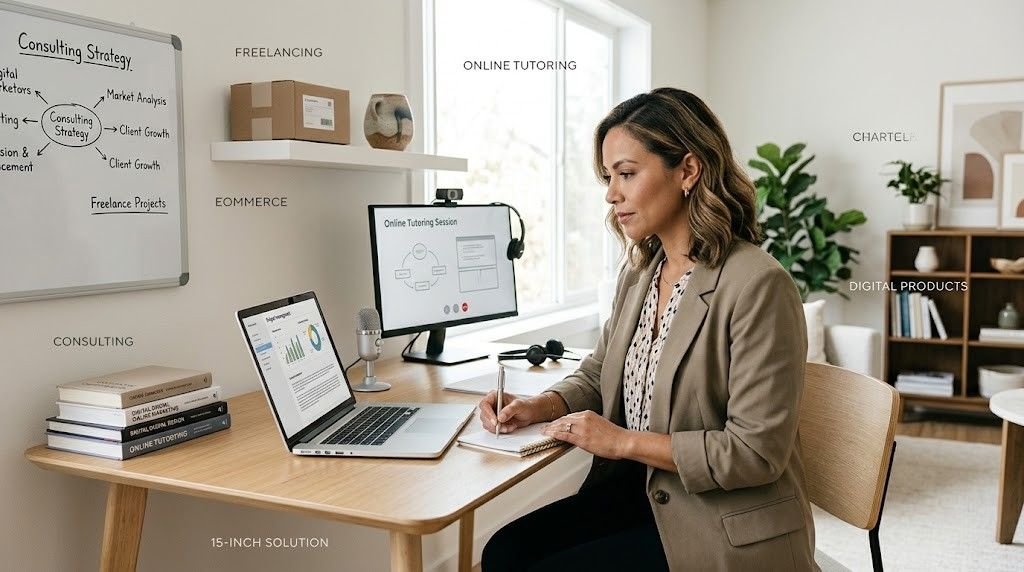

Starting a business from home can be a practical way to turn an existing skill, professional experience, creative ability, or useful product into a source of income. But working from home does not mean every business is cheap, simple, or automatically profitable.
The right home-based business depends on several factors, including your skills, budget, available space, time, customer demand, location, and the type of work you want to do.
In this guide, we’ll explore small business ideas from home across online services, freelancing, digital products, home-based products, professional services, and businesses that use your home as an administrative base.
You’ll also learn how to compare opportunities, estimate startup costs, find your first customers, validate an idea, and create a practical 30-day starting plan.
If you want a broader overview before choosing a home-based model, explore our complete guide to small business ideas.
What Is a Home-Based Business?
A home-based business is a business that is operated primarily from the owner’s home.
The home may be the place where you perform the actual work, manage customers, store products, handle administration, or operate the business online.
Home-based businesses can take several forms.
Fully Home-Based
These businesses can usually be operated remotely.
Examples include:
- Freelance writing
- SEO services
- Graphic design
- Virtual assistance
- Online tutoring
- Consulting
- Digital products
Home-Based With Local Service
The business is managed from home, but the actual service is delivered at the customer’s location.
Examples include:
- Pet care
- Local photography
- Certain repair services
- Cleaning coordination
- Some beauty services
Home-Based Product Business
Products may be created, packaged, stored, or managed from home.
Examples include:
- Handmade products
- Personalized gifts
- Sewing
- Baked goods where legally permitted
- Small ecommerce operations
Hybrid Business
Some activities happen at home while others happen elsewhere.
For example, a consultant may work from a home office but meet clients at their premises. A photographer may edit from home while shooting events at external locations.
The important point is that home-based does not necessarily mean entirely homebound.
Why Start a Business From Home?
There are several practical reasons entrepreneurs choose a home-based model.
Lower Overhead
Operating from home may eliminate or reduce the need for a separate office, retail space, or commercial workspace.
However, you may still have expenses for equipment, internet, software, insurance, inventory, marketing, utilities, shipping, licenses, and professional services.
Flexible Schedule
Home-based businesses can provide flexibility, particularly when the business is structured around appointments, projects, or online services.
But flexibility does not mean working without a schedule. Customers still expect reliability, deadlines, communication, and consistent service.
Easier to Start Small
Some home-based models allow you to test demand before investing heavily.
For example, a freelancer may start with a few clients instead of hiring employees immediately. A product seller may test a limited range before purchasing larger inventory.
Reduced Commute
Working from home can reduce commuting time and transportation requirements.
That can be particularly useful for people building a business alongside employment, education, family responsibilities, or other commitments.
Access to Online Customers
An internet-based business may serve customers beyond your local area.
A web designer, writer, editor, consultant, or online tutor can potentially work with clients in different cities or countries.
Building Around Existing Skills
One of the strongest advantages of home-based entrepreneurship is the ability to start with something you already know.
A professional skill can become a service. A creative hobby can potentially become a product business. Teaching experience can become tutoring or educational content.
27 Small Business Ideas From Home

1. Freelance Writing
Freelance writing is one of the most flexible businesses you can operate from home.
Services can include:
- Blog writing
- Website content
- Copywriting
- Product descriptions
- Email writing
- Editing
The strongest opportunities often come from developing expertise in a specific subject rather than trying to write about everything.
For example, someone with experience in technology may focus on technology content, while someone with financial knowledge may specialize in business or finance writing.
Who it may suit: Strong writers, researchers, communicators, and people with industry knowledge.
What you need: Computer, internet connection, writing samples, and a method for finding clients.
Potential advantage: Low physical overhead.
Challenge: Building a reliable client pipeline and avoiding price-based competition.
Business model: Fully remote.
Profitability depends on: Skill, specialization, pricing, client quality, workload, and operating costs.
2. Virtual Assistant Services
Virtual assistants provide remote administrative support to businesses and professionals.
Tasks may include:
- Email management
- Scheduling
- Research
- Data organization
- Customer communication
- Document management
- Administrative tasks
This can be particularly suitable for organized people who are comfortable using common online tools.
You can start with general administrative services and later specialize in a particular industry or task.
Business model: Fully remote.
Potential challenge: Some clients may require availability during specific working hours.
3. Online Tutoring
Online tutoring allows you to teach students without operating a traditional classroom.
Possible areas include:
- School subjects
- Languages
- Test preparation
- Programming
- Professional skills
- Music or other specialized subjects
Your qualifications may matter depending on the subject, level, platform, and location.
A strong tutor should focus not only on subject knowledge but also on communication, preparation, reliability, and the ability to explain difficult concepts clearly.
Business model: Fully remote.
Customer acquisition: Referrals, educational platforms, social media, local networks, and direct outreach.
4. Graphic Design
Graphic design can be operated entirely from a home office.
Potential services include:
- Social media graphics
- Logos
- Marketing materials
- Presentation design
- Advertisements
- Brand assets
A portfolio is often more useful than simply saying you are a designer.
You can create sample projects for a specific industry and use them to demonstrate your ability.
Best suited to: Creative people with design skills.
Challenge: Differentiating your service from inexpensive design providers.
5. Web Design
Web design is another home-based service that can serve clients remotely.
You could create websites for:
- Local businesses
- Professionals
- Small organizations
- Personal brands
- Service providers
- Online businesses
You may specialize in WordPress, ecommerce, landing pages, business websites, or website maintenance.
A useful way to start is to choose a specific type of customer and create a clear service package.
Business model: Fully remote or hybrid.
Profitability factors: Skill level, project pricing, client acquisition, maintenance services, and workload.
6. SEO Services
Search engine optimization can be operated from home and delivered remotely.
Services may include:
- Keyword research
- On-page SEO
- Local SEO
- Content optimization
- Technical SEO basics
- SEO audits
- Competitor research
SEO should be presented responsibly. No legitimate provider can guarantee a specific Google ranking because search results depend on many factors outside the provider’s direct control.
Best suited to: People interested in search engines, content, analytics, and digital marketing.
Business model: Fully remote.
Growth potential: A freelancer can potentially develop standardized services and later build an agency.
7. Social Media Management
Businesses often need help planning and managing their social media presence.
A home-based social media manager may provide:
- Content planning
- Scheduling
- Caption writing
- Community management
- Basic reporting
- Content coordination
The work can be performed remotely, although some local clients may occasionally require photography or video content at their business.
Business model: Remote or hybrid.
Challenge: Demonstrating measurable value and maintaining consistent client communication.
8. Online Consulting
Professionals can turn specialized knowledge into a consulting service.
Potential areas include:
- Marketing
- Business operations
- Technology
- Human resources
- Sales
- Industry-specific consulting
Consulting works best when you can clearly identify the problem you solve and the type of customer who needs your expertise.
Best suited to: Experienced professionals.
Important: Regulated professional advice may have specific licensing or qualification requirements.
9. Bookkeeping Services
Bookkeeping can be provided remotely to small businesses that need help maintaining financial records.
Services may include:
- Transaction recording
- Account organization
- Financial reports
- Invoice tracking
- Expense organization
Requirements and qualifications vary depending on the services offered and jurisdiction.
Business model: Fully remote.
Challenge: Accuracy, confidentiality, software knowledge, and compliance responsibilities.
10. Translation Services
People who are highly proficient in two or more languages can offer translation services from home.
Potential customers include:
- Businesses
- Websites
- Agencies
- Publishers
- Organizations
Specialization can be useful. For example, legal, technical, medical, or business translation may require subject knowledge in addition to language ability.
Business model: Fully remote.
11. Proofreading and Editing
Proofreading and editing can be provided from almost anywhere.
Potential work includes:
- Articles
- Business documents
- Websites
- Reports
- Educational materials where appropriate
- Marketing content
Different clients need different levels of editing, so define whether your service covers grammar correction, structural editing, fact-checking, formatting, or another specific task.
Best suited to: People with excellent language and attention-to-detail skills.
12. Digital Products
Digital products can include:
- Templates
- Checklists
- Spreadsheets
- Printables
- Guides
- Educational resources
- Design assets
The advantage is that the product can be created once and delivered digitally, but that does not mean sales happen automatically.
Marketing, distribution, audience building, product quality, customer support, and competition all affect the business.
Business model: Fully remote.
Potential advantage: No physical shipping for digital products.
13. Online Course Creation
If you have useful knowledge that can be taught systematically, an online course may be another home-based opportunity.
Courses can include:
- Recorded lessons
- Tutorials
- Structured learning materials
- Worksheets
- Demonstrations
Creating the course is only one part of the business.
You also need to consider audience development, marketing, customer support, updates, and competition.
Best suited to: Teachers, professionals, creators, and subject specialists.
Important: Avoid assuming that creating a course automatically produces passive income.
14. Print-on-Demand Business
Print-on-demand allows customers to order products featuring your designs while production and fulfillment are handled through a third-party service.
Products may include:
- Shirts
- Mugs
- Posters
- Notebooks
- Accessories
You need to consider:
- Design quality
- Product selection
- Platform fees
- Production costs
- Shipping
- Returns
- Customer service
Business model: Online.
Challenge: Competition and potentially limited margins.
15. Online Reselling
Online reselling involves sourcing products and selling them through marketplaces, social platforms, or your own ecommerce website.
The process typically involves:
- Finding products
- Calculating costs
- Creating listings
- Setting prices
- Handling customer questions
- Processing orders
- Managing shipping
Inventory can create financial risk, so testing products before purchasing large quantities can be useful.
Business model: Online or hybrid.
16. Handmade Products
Handmade products can be created and managed from a home workspace.
Examples include:
- Crafts
- Personalized gifts
- Home décor
- Artwork
- Accessories
The main challenge is that materials, packaging, storage, shipping, returns, and production time can affect profitability.
A handmade business may work better when it has a clear style or target customer rather than attempting to sell everything to everyone.
17. Home Bakery
A home bakery can specialize in products such as:
- Cakes
- Cookies
- Bread
- Desserts
- Customized baked goods
Pre-orders can help reduce unnecessary production and waste.
However, food businesses can be subject to local rules involving permits, inspections, food safety, labeling, zoning, and other requirements.
Business model: Home-based with local delivery or pickup.
Important: Check the applicable rules before selling food from your home.
18. Catering From Home
Small-scale catering may be possible from home where legally permitted.
Potential customers include:
- Small events
- Private gatherings
- Meetings
- Parties
The business requires careful planning around:
- Menu design
- Food safety
- Ingredient costs
- Orders
- Packaging
- Delivery
- Event requirements
Food businesses can involve more compliance and operational complexity than many digital service businesses.
19. Photography Editing Services
You do not necessarily need to be the photographer to build a photography-related home business.
If you have strong editing skills, you can work remotely on:
- Color correction
- Image retouching
- Photo organization
- Event photo editing
- Product photo editing
This can be particularly useful for photographers who want to outsource editing work.
Business model: Fully remote.
20. Video Editing
Video editing can be performed from a home workstation.
Potential clients include:
- YouTube creators
- Businesses
- Podcasters
- Agencies
- Social media creators
Services may include:
- YouTube editing
- Short-form videos
- Social media clips
- Business videos
- Captions
- Basic motion graphics
Challenge: Software, computer performance, storage, and editing time can affect operating costs.
21. Content Creation
Content creation can include:
- YouTube
- Blogging
- Short-form video
- Educational content
- Podcasts
- Social media
The business model may eventually involve advertising, sponsorships, affiliate programs, products, memberships, or services.
However, monetization generally requires audience development and should never be treated as guaranteed.
Best suited to: People who enjoy creating and publishing consistently.
22. Affiliate Content Business
An affiliate content business involves creating useful content and recommending relevant products or services through affiliate programs where available.
Content may include:
- Reviews
- Tutorials
- Comparisons
- Buying guides
- Educational articles
Success depends on audience trust, content quality, search or social distribution, product relevance, and commission structures.
Affiliate relationships should be disclosed where required, and you should follow the rules of the platforms and programs you use.
Business model: Fully remote.
23. Pet Sitting or Pet Care Coordination
Pet-related services can be managed from home or delivered locally depending on the model.
Possible services include:
- Pet sitting
- Dog walking
- Scheduling pet care
- Local pet-care coordination
If animals are kept at your home, space, safety, insurance, zoning, and local rules may become important.
Business model: Local or hybrid.
24. Sewing and Alteration Services
People with sewing skills can offer:
- Clothing alterations
- Repairs
- Custom garments
- Small-batch products
This can be operated from a home workspace, but equipment, fabric, storage, customer measurements, and production time all affect the business.
Best suited to: People with sewing or garment-production skills.
25. Personalized Gift Business
Personalized products can include:
- Customized gifts
- Event products
- Printed items
- Personalized accessories
- Celebration products
You can produce some products yourself or combine customization with third-party production.
Consider seasonal demand, equipment costs, packaging, shipping, and production time before investing heavily.
26. Home-Based Beauty Services
Some beauty businesses can operate from home where local rules permit.
Possible services depend on qualifications and regulations.
Important considerations include:
- Licensing
- Hygiene
- Safety
- Equipment
- Insurance
- Local regulations
- Customer privacy
Do not assume that a service can legally be offered from a residential property. Check the applicable requirements first.
27. Remote Customer Support Services
Businesses may outsource customer communication to remote workers or service providers.
Services can include:
- Email support
- Chat support
- Appointment management
- Customer communication
- Basic administrative support
This can be operated from home with a computer, reliable internet connection, and appropriate communication tools.
Best suited to: Organized people with strong communication and customer-service skills.
Best Home-Based Business Ideas With Low Startup Costs
“Low cost” is relative. Someone who already owns a computer, camera, tools, or other equipment may face very different startup expenses from someone starting from zero.
Some potentially low-overhead models include:
- Freelance writing
- Virtual assistance
- Online tutoring
- Consulting
- Proofreading
- Translation
- Social media management
- SEO services
- Digital products
The biggest advantage of these models is that some can be started by selling an existing skill rather than purchasing substantial inventory.
For a broader comparison, you can also explore low-cost business ideas if that supporting article is already live.
Best Online Businesses You Can Start From Home
Online businesses generally fall into several categories.
Selling Services
Examples:
- Writing
- SEO
- Web design
- Graphic design
- Consulting
- Virtual assistance
You are primarily selling your time, knowledge, or expertise.
Selling Physical Products
Examples:
- Online reselling
- Handmade products
- Print-on-demand
These businesses involve inventory, production, shipping, returns, or fulfillment considerations.
Selling Digital Products
Examples:
- Templates
- Guides
- Courses
- Educational resources
These avoid physical shipping but still require creation, marketing, distribution, and customer support.
Building an Audience
Examples:
- Blogging
- YouTube
- Short-form content
- Educational content
Audience-based models may take longer to monetize because you first need to build attention and trust.
For more options, explore online business ideas for beginners if the page is published and live.
Home-Based Business Ideas for Different Skills
Your existing abilities can be one of the best starting points for choosing a business.
If You Are Good at Writing
Consider:
- Freelance writing
- Editing
- Proofreading
- Blogging
- Copywriting
If You Are Good With Technology
Consider:
- Web design
- SEO
- Automation services
- Technical support
- Website maintenance
If You Are Creative
Consider:
- Graphic design
- Handmade products
- Photography editing
- Digital products
- Personalized gifts
If You Are Good at Teaching
Consider:
- Online tutoring
- Online courses
- Educational content
- Coaching where appropriate
If You Are Organized
Consider:
- Virtual assistance
- Bookkeeping
- Administrative services
- Customer support
If You Have Practical Skills
Consider:
- Sewing
- Repairs
- Food-related businesses where legally permitted
- Local services
If you want to explore more options, consider business ideas based on your skills, experience, and interests.
Home-Based Business Ideas for Women
Women can build almost any type of home-based business that fits their skills, resources, schedule, and goals.
Potential options include:
- Freelancing
- Online tutoring
- Virtual assistance
- Handmade products
- Digital products
- Consulting
- Online services
- Personalized products
- Home bakery where legally permitted
The important consideration is not whether a business is traditionally associated with women. Instead, evaluate the opportunity based on skills, customer demand, startup requirements, flexibility, and long-term goals.
For additional options, see small business ideas for women if that article is already published.
Home-Based Business Ideas for Teens and Young People
Young people can explore age-appropriate business activities such as:
- Tutoring
- Graphic design
- Video editing
- Content creation
- Pet care
- Simple local services
- Handmade products
Depending on age and location, parental involvement, platform rules, employment restrictions, permits, contracts, and financial requirements may apply.
The simplest starting point is often a low-risk activity that uses an existing skill.
Explore more business ideas for teens when that supporting article is live.
How Much Does It Cost to Start a Home-Based Business?
There is no universal startup cost for a home business.
A freelance writer may already own the necessary equipment, while a home product business may require inventory, packaging, tools, and storage.
A useful way to estimate costs is to divide them into two categories.
One-Time Costs
Potential examples include:
- Computer or equipment
- Website setup
- Initial inventory
- Tools
- Branding
- Licenses
- Furniture
- Specialized equipment
Recurring Costs
Potential expenses include:
- Internet
- Software
- Advertising
- Supplies
- Insurance
- Platform fees
- Shipping
- Professional services
- Replacement equipment
The U.S. Small Business Administration recommends researching startup costs and planning expenses before launching. Its resources cover business planning, market research, competitive analysis, and startup-cost calculations. See the SBA business planning resources for U.S.-focused guidance.
How to Choose the Right Home-Based Business
Choosing the right opportunity is more important than simply choosing the most popular idea.
Step 1: Identify Your Skills
List the skills you already have.
Consider professional skills, technical abilities, creative skills, communication skills, and practical abilities.
Step 2: Decide Your Budget
Determine how much you can realistically invest without putting essential personal finances at risk.
Step 3: Decide How Much Time You Have
A business operated for a few hours each week requires a different model from a full-time business.
Step 4: Identify a Customer Problem
Start with demand rather than simply choosing an idea because it sounds interesting.
Ask:
- Who has the problem?
- How serious is it?
- How do they currently solve it?
- Are they already spending money on alternatives?
Step 5: Research Competitors
Look at:
- Services
- Pricing
- Positioning
- Reviews
- Customer complaints
- Gaps in the market
Competition can provide useful information about what customers already expect.
Step 6: Estimate Costs
Calculate both startup and recurring expenses.
Step 7: Test the Idea
Create a small offer before making a large investment.
Step 8: Collect Feedback
Talk to potential customers and, where possible, actual paying customers.
Step 9: Improve the Offer
Adjust pricing, positioning, service features, or product design based on evidence.
Step 10: Decide Whether to Scale
Increase spending only when your early results provide a reasonable basis for expansion.
For a broader framework, focus on the key factors that can help you choose the right business idea.
How to Validate a Home Business Idea
One of the biggest differences between an interesting idea and a viable business is customer behavior.
People saying, “That’s a great idea,” is not the same as someone paying for the product or service.
Practical validation methods include:
- Talking to potential customers
- Studying competitors
- Searching for existing demand
- Examining online communities
- Offering a pilot service
- Creating a simple landing page
- Testing pre-orders where appropriate
- Collecting customer feedback
- Measuring inquiries
- Tracking conversions
Start small whenever possible.
If your first test produces little interest, that does not necessarily mean entrepreneurship is impossible. It may mean that the target customer, offer, pricing, or positioning needs to change.
You can also take time to validate your business idea before deciding whether to move forward.
Market Research for a Home-Based Business
Market research helps you understand whether an opportunity has a realistic customer base.
Research:
- Target audience
- Local demand
- Online demand
- Competitors
- Pricing
- Customer problems
- Search behavior
- Existing alternatives
- Geographic limitations
For U.S.-focused research, the Census Bureau small business data provides access to datasets, statistics, and other business information.
Remember that government datasets are useful for understanding markets, but they do not automatically prove that your specific business idea will succeed.
Legal and Tax Considerations
Home-based businesses are still businesses, so legal and tax requirements may apply.
Depending on the business and location, you may need to consider:
- Business registration
- Licenses and permits
- Zoning or home-business restrictions
- Food safety requirements
- Professional licensing
- Insurance
- Recordkeeping
- Taxes
- Separate business finances
Rules vary significantly between countries, states, provinces, cities, and industries.
For readers operating in the United States, the IRS resources for small businesses provide information on areas such as business structures, recordkeeping, employer identification numbers, and taxes.
The IRS also provides federal business tax resources covering federal business tax categories.
These IRS resources are U.S.-specific. Readers in other countries should consult their own tax authority and local government agencies.
How to Get Your First Customers From Home
Starting the business is only half the challenge. You also need customers.
Personal Network
Let relevant people know what service or product you offer without spamming them.
Local Outreach
For locally focused businesses, identify businesses or customers in your service area and make a clear, useful offer.
Social Media
Use social platforms to demonstrate expertise, show products, answer questions, and build trust.
Freelance Platforms
Marketplaces can help beginners find initial opportunities, although competition and platform fees should be considered.
Local Business Outreach
For B2B services such as SEO, web design, social media management, and bookkeeping, direct outreach can be one potential customer-acquisition method.
Referrals
Satisfied customers can become a source of future business.
Content Marketing
Educational articles, videos, tutorials, and useful social content can build visibility over time.
Common Mistakes to Avoid
Home-based entrepreneurs can make many of the same mistakes as traditional businesses.
Avoid:
Choosing a Business Only Because It Is Trending
A trend can disappear before you build a sustainable customer base.
Spending Too Much Before Validation
Do not purchase large amounts of equipment or inventory before confirming demand when a smaller test is possible.
Ignoring Local Rules
Operating from home does not automatically exempt you from permits, zoning, licensing, tax, or safety requirements.
Underpricing Services
Low prices may attract customers but can make the business difficult to sustain if they do not cover your real costs and time.
Mixing Personal and Business Finances
Separate records make it easier to understand how the business is actually performing.
Trying to Serve Everyone
A specific customer profile can make your offer and marketing clearer.
Buying Unnecessary Equipment
Buy according to actual business requirements rather than assuming more equipment will automatically produce better results.
Building a Website Before Defining the Offer
A website cannot compensate for an unclear product, service, or target customer.
Ignoring Customer Feedback
Customers can reveal problems you did not notice.
Expecting Immediate Profits
A new business may need time to develop customers, reputation, systems, and consistent revenue.
Copying Competitors
Study competitors, but create your own positioning and value proposition.
Failing to Track Expenses
Revenue without expense tracking does not tell you whether the business is financially healthy.
Avoid common mistakes that can make it harder to build a successful small business.
Home Business vs. Traditional Business
| Factor | Home-Based Business | Traditional Business |
| Physical space | Usually lower requirement | May require dedicated location |
| Overhead | Can be lower | Often higher |
| Customer reach | Local or potentially global | Often location-dependent |
| Flexibility | Often higher | May be more fixed |
| Inventory | Depends on model | Depends on model |
| Employees | Optional initially | May be needed earlier |
| Scalability | Depends on business model | Depends on business model |
A home-based business is not automatically easier.
For example, an online consulting business may require little physical space but significant expertise and customer acquisition. A home bakery may operate from a residential kitchen but involve food safety, equipment, packaging, and local compliance requirements.
The business model matters more than the label “home-based.”
30-Day Plan to Start a Home-Based Business
Days 1–7: Research
Choose two or three possible ideas.
Then:
- Evaluate your skills
- Identify potential customers
- Research competitors
- Study pricing
- Identify legal requirements
Do not spend heavily during this stage.
Days 8–14: Build Your Offer
Choose one idea.
Define:
- Target customer
- Problem you solve
- Product or service
- Basic pricing
- Delivery method
- Estimated costs
Days 15–21: Test
Start contacting potential customers.
You can:
- Offer a pilot
- Ask for feedback
- Test a service package
- Publish a simple offer
- Contact relevant businesses
- Test customer interest
Days 22–30: Review
Track:
- Inquiries
- Customers
- Revenue
- Expenses
- Feedback
- Time spent
- Problems encountered
Then decide whether to continue, modify the offer, or test a different approach.
For additional launch guidance, focus on the key first steps involved in starting a small business.
How to Compare Home-Based Business Ideas
Before committing to one opportunity, score your options.
| Factor | Idea A | Idea B | Idea C |
| Startup cost | |||
| Existing skills | |||
| Learning curve | |||
| Customer demand | |||
| Competition | |||
| Time required | |||
| Flexibility | |||
| Profit margin potential | |||
| Recurring revenue potential | |||
| Scalability | |||
| Legal requirements | |||
| Personal interest |
The purpose is not to find a perfect score.
Instead, the comparison helps you see which opportunity fits your actual circumstances.
A business requiring expensive equipment may be a poor fit if your budget is limited. A low-cost online service may be attractive, but it may require stronger marketing and competition management.
Conclusion
There are many small business ideas from home, ranging from freelance services and online consulting to digital products, ecommerce, tutoring, creative businesses, and local services.
The best choice depends on your skills, available time, budget, customer demand, space, location, legal requirements, and long-term goals.
Service businesses can sometimes be tested without large inventory investments. Online businesses can potentially reach customers beyond your local area. Product businesses can offer different opportunities but may require more attention to inventory, shipping, equipment, and compliance.
The smartest approach is usually to start with research rather than a large financial commitment.
Choose a few ideas, identify the customer problem, estimate the costs, test the offer, collect feedback, and only then decide whether to invest more.
The goal is not simply to find a business you can run from home. It is to find a business model that makes sense for you and the customers you want to serve.
Frequently Asked Questions
What are the best small business ideas from home?
There is no single best option for everyone. Freelancing, online tutoring, virtual assistance, web design, SEO, consulting, digital products, video editing, reselling, and handmade products can all be considered depending on your skills, budget, demand, and goals.
What is the easiest home-based business to start?
Some service businesses can have fewer upfront requirements than inventory-heavy businesses. Writing, virtual assistance, tutoring, consulting, proofreading, and certain digital services may be relatively simple to test, but the difficulty still depends on your skills and ability to find customers.
What business can I start from home with little money?
Skill-based businesses are often worth considering when capital is limited. Examples include freelance writing, tutoring, virtual assistance, consulting, proofreading, translation, social media management, and some SEO services.
Can I start an online business from home?
Yes. Common models include freelancing, web design, SEO, graphic design, virtual assistance, online tutoring, digital products, online courses, content creation, affiliate content, reselling, and print-on-demand.
How do I know if my home business idea will work?
You cannot know with certainty before testing it. Research customers and competitors, study pricing, estimate costs, create a small offer, and test whether real customers show interest or pay for the product or service.
Do I need a license for a home-based business?
It depends on your location and business type. Food businesses, beauty services, professional services, and businesses involving customers at your home may have specific requirements. Check the rules that apply in your city, state, province, or country.
How can I get my first customers for a home business?
Potential approaches include personal networking, local outreach, social media, freelance marketplaces, direct business outreach, referrals, and content marketing. The best method depends on whether you sell locally, online, to consumers, or to other businesses.
admin
Practical business guides, useful tools, and technology insights from BusinessNexa.



Work smarter with practical business tools.
Explore useful calculators, guides and tools for modern businesses.