
Business Bridging Loans South Africa: A Complete Guide for Businesses
A business can secure a valuable contract, receive a large purchase order, or win a new customer without having enough […]


A business can secure a valuable contract, receive a large purchase order, or win a new customer without having enough cash available to deliver the work. Suppliers may require upfront payment, employees need wages, and operational expenses cannot always wait until a customer settles an invoice.
For South African businesses facing this situation, business bridging loans in South Africa can provide short-term working capital to cover the gap between paying business expenses and receiving expected revenue.
Bridging finance is particularly relevant to companies with confirmed commercial contracts, purchase orders, or identifiable incoming payments. It can help businesses purchase stock, pay suppliers, cover project expenses, and fulfil customer commitments without immediately exhausting their existing cash reserves.
However, these loans are not suitable for every financial situation. Interest, fees, repayment deadlines, and customer payment delays can create additional pressure if the funding is not carefully planned.
This guide explains how business bridging finance works in South Africa, who may qualify, where businesses can find funding, how much it may cost, and what to consider before applying.
What Are Business Bridging Loans in South Africa?
Business bridging loans are short-term financing arrangements that help companies manage temporary working-capital shortages.
They are generally used when a business has a commercial opportunity or expected payment but needs money before that income becomes available.
For example, consider a South African wholesale supplier that receives a purchase order worth R350,000 from a retailer. The supplier needs to purchase stock, arrange transportation, and pay operating expenses before delivering the order.
However, the retailer will only pay after receiving the goods and completing its payment process.
The supplier may have a profitable opportunity but insufficient available cash to fulfil the order.
A bridging loan could provide the working capital needed to purchase the stock and complete the delivery. The business can then use the customer’s payment to repay the financing, subject to the agreed repayment terms.
South Africa’s Small Enterprise Development and Finance Agency (SEDFA) offers a bridging loan product specifically designed for businesses fulfilling confirmed business-to-business contracts or purchase orders.
Its published programme describes short-term working-capital support for stock and operating expenses, with repayment linked to the contract period, up to 12 months.
This illustrates an important characteristic of contract-based bridging finance: the funding is connected to a specific commercial activity rather than simply providing unrestricted money for long-term business expansion.
How Do Business Bridging Loans Work?
The purpose of bridging finance is to provide money when a business needs to spend before receiving payment.
Although the application process differs between lenders, the general arrangement follows a similar sequence.
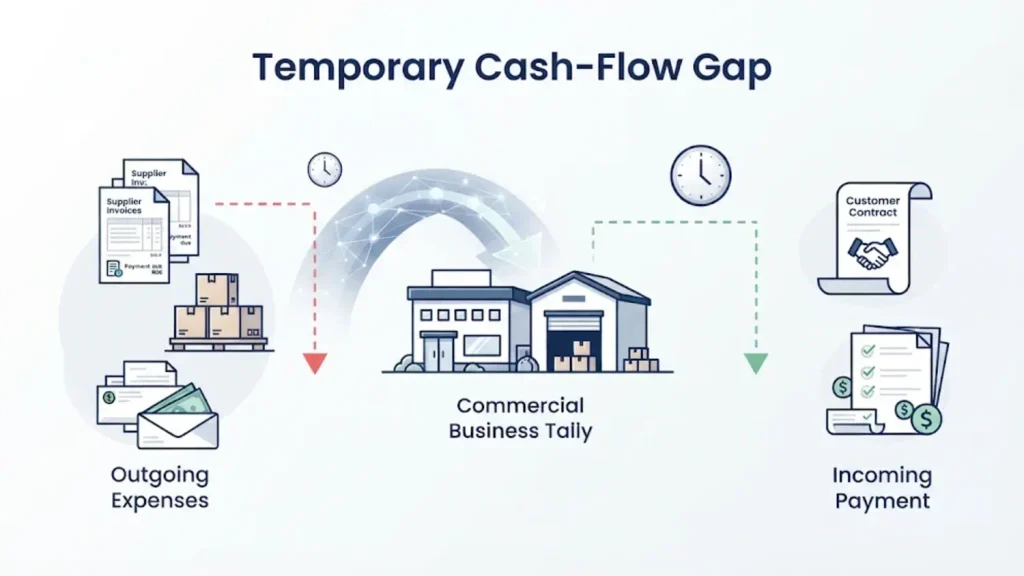
1. A Business Secures a Commercial Opportunity
The business receives a confirmed purchase order, signs a contract, completes work, or identifies an expected customer payment.
This creates a financial requirement that needs to be addressed before the revenue arrives.
2. The Business Calculates Its Funding Gap
The owner calculates how much money is needed to complete the commercial activity.
For example, expenses may include:
- Purchasing inventory or raw materials.
- Paying suppliers and subcontractors.
- Covering employee wages.
- Arranging transportation and delivery.
- Paying project-related operating expenses.
The amount requested should reflect the actual funding requirement.
3. The Business Applies for Financing
The company approaches a suitable finance provider and submits the required documents.
Depending on the product, the lender may request business registration details, financial records, bank statements, contracts, purchase orders, and project information.
4. The Lender Assesses the Application
The lender evaluates the business, its financial position, the underlying commercial transaction, and the proposed repayment source.
A confirmed contract may strengthen an application, but it does not automatically guarantee approval.
5. Funds Are Released
If the application is approved and the agreement is completed, the lender releases the funds according to the agreed arrangement.
The business uses the financing for its intended purpose.
6. The Business Repays the Loan
Repayment takes place according to the agreement.
Some facilities require scheduled instalments, while others may involve settlement after an expected payment arrives.
The business should understand exactly when repayment becomes due and what happens if the customer pays late.
Who Can Benefit From Business Bridging Finance?
Bridging finance is most useful when a business has a temporary cash-flow requirement connected to a genuine commercial opportunity.
Different industries can experience this problem for different reasons.
Construction and Contracting Companies
Construction businesses frequently need money before receiving progress payments or final project settlements.
They may have to purchase building materials, hire subcontractors, pay workers, and arrange equipment before receiving money from the client.
A suitable bridging facility can help an eligible contractor meet these initial expenses.
Wholesale and Distribution Businesses
Wholesalers may receive large orders that require significant inventory purchases.
If customers pay after delivery, the business must finance the stock before receiving revenue.
Short-term funding can help suppliers manage this timing difference.
Manufacturing Businesses
Manufacturers often purchase raw materials and pay production expenses before delivering finished goods.
A confirmed order may create an opportunity to increase production, but the business still needs sufficient working capital to complete it.
Transport and Logistics Companies
Transport businesses may need to pay fuel, maintenance, drivers, and subcontractors before receiving payment for completed deliveries.
Funding can help manage these expenses when the expected revenue is sufficiently reliable.
Professional Service Providers
Consulting firms, maintenance companies, and other service businesses may have to pay employees and contractors before clients settle invoices.
Depending on the lender, a suitable short-term facility may help manage these operational requirements.
Small and Medium-Sized Enterprises
SMEs can experience cash-flow pressure when their customers have longer payment terms than their suppliers.
Bridging finance may help manage this gap, particularly when the business has established trading activity and documented incoming revenue.
What Types of Business Bridging Finance Are Available in South Africa?
The term bridging finance can describe several different funding arrangements. Understanding the differences helps business owners choose a product that matches their actual requirement.
Contract and Purchase Order Financing
Contract finance provides funding to businesses that have secured a commercial contract or purchase order but need money to fulfil the commitment.
It may cover expenses such as stock, materials, labour, and other project costs.
SEDFA’s bridging loan programme is an example of this type of financing.
Some commercial banks also offer contract-based funding. For example, Absa’s SME contract financing programme provides eligible businesses with funding against qualifying public-sector contracts or purchase orders, subject to its requirements.
Invoice Financing
Invoice financing allows a business to access funds against qualifying unpaid customer invoices.
Instead of waiting until the customer completes the payment process, the business may receive an advance against the outstanding invoice.
The provider’s fees, advance percentage, and repayment arrangement depend on the facility.
This option is particularly relevant when the business has already delivered goods or services and issued an invoice.
Short-Term Working Capital Finance
Some lenders offer short-term business funding that can be used to manage operational expenses.
Depending on the agreement, funds may support supplier payments, inventory purchases, wages, or other working-capital needs.
Unlike contract-specific bridging facilities, these products may assess the company’s wider trading performance and cash flow.
Revolving Credit Facilities
A revolving credit facility provides an approved funding limit that a business can draw from when needed.
After repaying the borrowed amount, the available credit may become accessible again under the agreement.
SEDFA also offers revolving credit for qualifying established businesses, particularly those delivering contracts with defined timeframes and values.
This can be useful for companies with recurring working-capital requirements rather than a single temporary funding gap.
Where Can Businesses Get Bridging Loans in South Africa?
South African businesses can explore several financing institutions and providers.
The following organisations offer relevant business finance products. However, not all of their products are dedicated bridging loans.
1. Small Enterprise Development and Finance Agency (SEDFA)
SEDFA is an important starting point for small businesses seeking development finance.
Its bridging loan programme focuses on businesses that have secured firm business-to-business contracts or purchase orders.
The funding is intended to help companies cover stock and operating costs while waiting for payment.
According to its published programme:
- Financing is designed for qualifying contract-based business requirements.
- Funding can support stock and operating expenses.
- Repayment is linked to the contract period.
- The published maximum repayment period is 12 months.
Businesses can review the official SEDFA bridging loan programme to understand the current application process and requirements.
2. Genfin
Genfin is a South African business finance provider offering short-term funding products.
Its Opportunity Bridge Loan is designed for registered businesses that want to take advantage of a trading opportunity before their customers pay.
Examples include purchasing materials for a new contract, buying bulk inventory, and funding awarded tenders.
The provider publishes specific qualifying conditions and financing costs for this product. Businesses should check its current agreement carefully, particularly the initial repayment period, settlement cost, and what happens if the loan is not settled within that period.
More details are available on Genfin’s business bridging loan page.
3. Absa
Absa provides SME contract financing for qualifying businesses that have received eligible public-sector contracts or purchase orders.
Its published programme includes funding from R50,000 to R3 million, with a maximum loan term of five years, subject to approval and other qualifying conditions.
The programme also specifies that funds are paid directly to suppliers.
This is contract financing rather than a conventional short-term bridging product, so applicants should compare its structure with their actual funding requirements.
Visit Absa’s SME contract financing information for the published eligibility criteria.
4. African Bank
African Bank has expanded its presence in the South African SME lending market through an online business financing platform.
Its business lending proposition includes term loans, revolving credit facilities, and invoice financing.
These products may help eligible companies address different working-capital requirements, although they should not automatically be treated as identical to a contract-specific bridging loan.
Businesses interested in this provider should examine the available facilities, repayment arrangements, and qualification criteria before choosing a product.
Our dedicated guide to African Bank bridging loan options will explore its business financing products and how they may fit different short-term funding needs.
Important: The providers listed above have different financing structures. Their inclusion is informational and does not represent a recommendation, approval guarantee, or comparison of the cheapest available loans.
What Are the Eligibility Requirements for a Business Bridging Loan?
There is no universal eligibility checklist for all South African bridging finance providers.
Each lender determines its own requirements based on the product, loan amount, repayment period, security, and financial risk.
However, applicants should generally be prepared to demonstrate the following.
Registered Business
Many commercial providers require applicants to operate through a registered South African business.
Some funding programmes may also specify particular ownership, residency, or business-structure conditions.
Check the provider’s rules before preparing an application.
Confirmed Contract or Purchase Order
Contract-based lenders may require evidence that the business has secured genuine commercial work.
Documents may include:
- Signed customer contracts.
- Approved purchase orders.
- Award letters for tenders.
- Project details and timelines.
- Customer payment terms.
The lender may assess whether the contract is commercially viable and whether the customer can reasonably be expected to make payment.
Business Bank Statements
Bank statements help providers understand the company’s trading activity, revenue, expenses, and financial commitments.
Some lenders may request three to six months of statements, while others have different requirements.
Financial Statements and Cash Flow Projections
Financial records help demonstrate whether the business can manage the additional debt.
Depending on the product, providers may request historical accounts, management accounts, project budgets, or cash-flow forecasts.
Tax and Registration Documents
Applicants may need to provide:
- CIPC registration information.
- Company ownership or director details.
- SARS tax compliance documentation.
- Identification documents.
- Proof of business address.
The exact checklist depends on the funding institution.
Repayment Capacity
A business must have a realistic repayment strategy.
The lender may consider existing debt, expected customer payments, the financial strength of the business, and possible delays in completing the contract.
A large purchase order alone does not prove that the business can repay a loan.
How Much Do Business Bridging Loans Cost in South Africa?
The cost of bridging finance depends on the lender, financing structure, repayment period, loan amount, security, and financial risk.
There is no single interest rate that applies to all South African business bridging loans.
Before accepting an offer, examine the complete cost rather than focusing only on the advertised rate.
Interest Charges
Interest may be calculated using different methods.
Some providers quote monthly rates, while others use annual rates or a fixed financing charge.
Always confirm how the amount is calculated and whether interest applies to the original principal or the outstanding balance.
Administration and Arrangement Fees
A lender may charge an arrangement or administration fee for establishing and processing a facility.
Ask whether the amount is deducted from the funds released or added to the repayment balance.
Legal and Other Charges
Depending on the transaction, additional costs may include legal documentation, security registration, valuations, or other agreed expenses.
Check which charges are mandatory and which are optional.
Example: Calculating a Bridging Loan Cost
Suppose a South African business borrows R200,000 to fulfil a confirmed purchase order.
For illustration, assume the lender charges a once-off financing cost of 10%.
| Description | Amount |
|---|---|
| Loan principal | R200,000 |
| Illustrative financing cost | R20,000 |
| Total repayment | R220,000 |
This is a hypothetical example, not an actual lender quotation or an estimate of average market rates.
The example shows why business owners should compare the total amount payable before choosing a facility.
A lower advertised rate does not necessarily mean a cheaper loan if additional charges apply.
Business Bridging Loans vs Traditional Business Loans
Bridging finance and conventional business loans both provide access to capital, but their purposes can be different.
| Factor | Bridging Finance | Traditional Business Loan |
|---|---|---|
| Main purpose | Cover a temporary funding gap | Finance broader business needs |
| Duration | Usually short-term | Often medium or long-term |
| Typical requirement | Contract, order, or expected payment | Business financial position and funding purpose |
| Repayment | May be connected to incoming revenue | Usually scheduled repayments |
| Common uses | Stock, suppliers, project expenses | Expansion, equipment, investment, working capital |
| Main consideration | Timing and reliability of expected payment | Long-term affordability |
A bridging facility may suit a company that needs immediate working capital to complete a specific commercial transaction.
A traditional business loan may be more appropriate when the company wants to purchase equipment, expand operations, or finance a longer-term investment.
The right option depends on the amount needed, how long the business needs it, and its ability to repay.
What Are the Benefits of Business Bridging Loans?
When used appropriately, bridging finance can offer several advantages.
Helps Manage Temporary Cash-Flow Gaps
A company may have enough expected revenue but insufficient cash available today.
Short-term funding can help manage the timing difference between business expenses and customer payments.
Supports Contract Fulfilment
Businesses can sometimes secure contracts that require significant upfront expenditure.
Suitable financing may help them purchase materials, pay suppliers, and complete the work.
Protects Existing Working Capital
Instead of using all available business cash for one large project, a company may use an appropriate financing facility to maintain some liquidity for other operating requirements.
This depends on whether the financing cost is justified.
Creates Access to Commercial Opportunities
Some businesses decline profitable orders because they cannot afford the initial expenses.
Bridging finance may help eligible companies consider opportunities that would otherwise be difficult to fund.
Helps Businesses Manage Supplier Commitments
When suppliers require payment before customer revenue arrives, short-term financing may help maintain business relationships and keep operations moving.
These benefits depend on responsible borrowing, suitable loan terms, and reliable repayment arrangements.
What Are the Risks of Business Bridging Finance?
Bridging finance can create additional financial pressure if the business does not plan carefully.
Before applying, consider the following risks.
High Financing Costs
Some short-term facilities carry significant financing charges.
A business should compare the total borrowing cost with the expected profit from the commercial opportunity.
If the financing cost consumes most of the expected margin, the transaction may not be worthwhile.
Delayed Customer Payments
A business may plan to repay the loan after receiving an invoice payment.
However, customers sometimes delay payments because of administrative problems, disputes, incomplete documentation, or their own cash-flow difficulties.
The loan agreement may still require repayment on the original due date.
Security and Personal Guarantees
Some providers may require collateral, while others offer unsecured financing.
If a company pledges assets, default may expose those assets to enforcement under the agreement.
A personal guarantee can also create personal financial liability for the person signing it.
Understand these obligations before accepting funding.
Borrowing More Than Necessary
Taking a larger loan than required can increase financing costs and repayment pressure.
Calculate the actual cash-flow gap and avoid borrowing extra money without a clear business purpose.
Repeated Dependence on Short-Term Loans
Bridging finance should address a temporary funding problem, not hide an ongoing business deficit.
If a company regularly needs new borrowing to repay previous loans, it should review its pricing, payment terms, operating expenses, and cash-flow management.
How to Apply for a Business Bridging Loan in South Africa
Preparing an application properly can help a business understand its funding options and reduce avoidable delays.
Step 1: Identify the Purpose of Financing
Explain exactly why the money is needed.
For example, the requirement may be to purchase stock for a confirmed order, pay suppliers, or cover project expenses before a customer makes payment.
A clearly defined purpose helps identify suitable funding products.
Step 2: Calculate the Required Amount
Prepare a detailed breakdown of the expenses.
Include supplier quotations, project costs, transport expenses, wages, and any other relevant payments.
Avoid requesting an amount that is not supported by the business requirement.
Step 3: Prepare Supporting Documents
Organise your business and financial records.
A useful preparation checklist includes:
- Company registration documents.
- Director or owner identification.
- Business bank statements.
- Financial statements or management accounts.
- Signed contracts or purchase orders.
- Project budgets and cash-flow projections.
- Supplier quotations.
- Tax compliance information, where required.
The final checklist must come from the selected lender.
Step 4: Compare Finance Providers
Contact more than one suitable provider where possible.
Compare funding limits, total repayment amounts, fees, repayment dates, security requirements, and approval conditions.
Step 5: Submit the Application
Complete the application and provide accurate supporting information.
Make sure that contract values, expected payment dates, and business financial figures are consistent across the documents.
Step 6: Review the Finance Agreement
Before signing, check:
- The approved amount.
- The total repayment.
- Interest and other charges.
- Repayment dates.
- Early settlement conditions.
- Late-payment consequences.
- Security and guarantee obligations.
- What happens if the customer does not pay on time.
Seek independent financial or legal advice if any provision is unclear.
How to Choose the Right Bridging Finance Provider
The fastest funding option is not necessarily the most suitable one.
A business should evaluate each provider against its actual financing needs.
Compare the Total Cost
Ask for a complete written breakdown of all charges.
Calculate the amount the business will receive and the total amount it must repay.
Understand the Repayment Structure
Check whether repayments are made monthly, weekly, or as a lump sum.
If the loan depends on an incoming customer payment, confirm what happens if that payment is delayed.
Check Funding Conditions
Some providers only finance confirmed contracts, while others may assess general trading activity or unpaid invoices.
Choose a product whose requirements match the business situation.
Review Security Requirements
Understand whether the lender requires business assets, property, or personal guarantees.
Consider the consequences of default before putting valuable assets at risk.
Verify the Provider
Check the lender’s legal identity, official website, contact information, contractual documents, and applicable regulatory obligations.
Do not transfer advance fees to an unverified intermediary or rely on verbal funding promises.
Alternatives to Business Bridging Loans
Bridging finance is not the only way to manage a temporary cash-flow shortage.
Depending on the business situation, other options may be more suitable.
Negotiate Better Customer Payment Terms
A business can sometimes request an upfront deposit, milestone payments, or partial payment before delivery.
This can reduce the amount of external funding required.
Negotiate Supplier Credit
Some suppliers may agree to deferred payment arrangements for established customers.
This can help reduce the initial cash requirement.
Consider Invoice Financing
If the business has already delivered its goods or services and issued an eligible invoice, invoice financing may provide access to funds before the customer settles the invoice.
Explore Revolving Credit
Businesses with recurring working-capital needs may benefit from an approved revolving facility.
It can provide access to funds when needed, subject to the agreement and available credit limit.
Use Existing Business Reserves
If the business has sufficient cash reserves, using them may be cheaper than taking short-term finance.
However, the owner should ensure that enough money remains available for essential expenses and unexpected costs.
Is Business Bridging Finance Regulated in South Africa?
South African business owners should understand that the legal treatment of credit agreements depends on the nature of the transaction and the parties involved.
The National Credit Act 34 of 2005 establishes a framework for applicable credit agreements in South Africa.
However, the Act does not apply identically to every business borrowing arrangement. Section 4 includes exclusions relating to certain juristic persons based on asset value or annual turnover, as well as other statutory conditions.
This means a company should not assume that every business bridging loan receives the same protections as an ordinary consumer loan.
Before signing a financing agreement, businesses should verify the provider’s regulatory status and understand which legal requirements apply to their particular transaction.
For authoritative background, consult the National Credit Act on the South African Department of Justice website.
Where the agreement involves substantial borrowing, collateral, or personal guarantees, obtaining independent South African legal advice is sensible.
Frequently Asked Questions About Business Bridging Loans in South Africa
1. What are business bridging loans in South Africa?
Business bridging loans are short-term financing arrangements that help companies cover temporary cash-flow gaps. They can finance stock, supplier payments, project expenses, and other working-capital requirements while businesses wait for expected revenue.
2. Can a small business qualify for bridging finance in South Africa?
Yes, eligible small businesses can apply. Requirements depend on the lender and may include business registration, financial records, bank statements, confirmed contracts, purchase orders, and evidence of repayment capacity.
3. Do I need a purchase order to get a business bridging loan?
Not always. Some providers specifically require confirmed contracts or purchase orders, while others assess business turnover, outstanding invoices, or wider cash-flow performance.
4. How much can a business borrow?
The available amount depends on the provider, the business’s financial position, the underlying transaction, and its repayment ability. Different lenders have different minimum and maximum funding limits.
5. How long does a business bridging loan last?
Repayment periods vary. Some commercial facilities are designed for a few weeks or months. SEDFA’s published bridging loan programme links repayment to the contract period, up to 12 months.
6. Can a startup apply for bridging finance?
Some providers may consider newer businesses, but startups without an established trading history can face additional eligibility challenges.
A confirmed commercial contract, realistic project budget, and credible repayment source may strengthen an application, depending on the lender.
7. Are bridging loans secured or unsecured?
Both arrangements may be available. Some providers require collateral or personal guarantees, while others offer unsecured products to qualifying businesses.
Always review the actual security provisions in the agreement.
8. Can I repay a bridging loan early?
That depends on the provider’s conditions. Some agreements allow early settlement, while others may calculate financing charges differently.
Request written confirmation of early repayment terms before accepting an offer.
9. What happens if a customer pays late?
The business may still have to repay the lender on the agreed date. Late customer payments can therefore create financial pressure and may result in additional charges or enforcement under the agreement.
Contact the lender promptly if repayment difficulties become likely.
10. Are business bridging loans better than traditional business loans?
Neither option is automatically better. Bridging finance is generally more suitable for temporary funding gaps, while traditional business loans may be more appropriate for longer-term investments and broader business requirements.
The right option depends on the funding purpose, overall cost, and repayment capacity.
Final Thoughts
Business bridging loans in South Africa can help eligible companies manage temporary working-capital shortages, fulfil confirmed contracts, and take advantage of commercial opportunities.
They can be particularly useful for suppliers, contractors, manufacturers, and SMEs that need to pay expenses before receiving customer payments.
However, access to funding should not be the only consideration. Businesses must understand the total financing cost, repayment structure, eligibility conditions, and consequences of delayed customer payments.
Compare available providers, prepare accurate financial documents, and ensure that the expected business income can realistically support repayment.
The best financing decision is one that solves an immediate cash-flow problem while protecting the company’s longer-term financial stability.
admin
Practical business guides, useful tools, and technology insights from BusinessNexa.



Work smarter with practical business tools.
Explore useful calculators, guides and tools for modern businesses.