
Starting a business can be exciting, but choosing the right idea is often the hardest part. There are thousands of potential businesses you could start, from freelance services and online businesses to local services, retail, and home-based ventures.
The best small business ideas are not necessarily the ones that look most profitable on paper. A good opportunity should also match your skills, available budget, schedule, location, customer demand, and willingness to handle the day-to-day work involved.
In this guide, we’ll compare practical small business opportunities, including low-cost, home-based, online, local, and service-based options. We’ll also explain how to evaluate an idea, estimate startup costs, research the market, validate demand, and decide which opportunity fits you best.
For a broader list of opportunities, you can also explore our complete guide to small business ideas.
What Makes a Small Business Idea a Good Choice?
Before choosing a business, look beyond the idea itself. Consider these factors:
Customer Demand
A business needs customers. Research whether people actually have the problem your product or service solves.
Startup Requirements
Some businesses require equipment, inventory, vehicles, premises, insurance, or licenses. Others can be started with a computer and an internet connection.
Your Skills
Your existing experience can reduce the time and money required to become competent. A business that matches your skills may be easier to launch.
Profit Potential
Revenue is not the same as profit. Consider pricing, operating expenses, taxes, marketing, equipment, software, transportation, and other costs.
Competition
Competition can be a positive sign because it demonstrates that customers already spend money in the market. Your challenge is finding a way to offer something useful or different.
Recurring Customers
Businesses with repeat customers can potentially create more predictable revenue than businesses that depend entirely on one-time transactions.
Scalability
Some businesses grow primarily by adding your personal working hours. Others can eventually use employees, contractors, technology, products, or systems to serve more customers.
Important: No business idea guarantees profitability. Your results depend on demand, execution, pricing, competition, costs, location, and many other factors.
27 Best Small Business Ideas to Consider
1. Freelance Writing
Freelance writing is one of the simplest online business models for people who have strong writing skills.
You can offer blog writing, website content, product descriptions, email copy, technical writing, or other specialized services.
Best for: Writers, students, researchers, and people with strong communication skills.
Startup requirements: Computer, internet connection, writing samples, and a way to find clients.
Advantages: Low startup cost, flexible schedule, and potential to work remotely.
Challenges: Finding consistent clients and competing on price.
First customers: Local businesses, agencies, websites, startups, and professional contacts.
2. Web Design Services
Small businesses often need websites but may not have the skills or time to build them themselves.
You can create websites using platforms such as WordPress or specialize in landing pages, business websites, ecommerce stores, or website maintenance.
Best for: People interested in design, WordPress, technology, or user experience.
Startup requirements: Computer, internet, web design skills, and portfolio.
Advantages: Can be operated from home and expanded into an agency.
Challenges: Competition and the need to keep learning.
3. Social Media Management
Businesses need consistent social media content but many owners don’t have time to manage their accounts.
A social media manager can create content calendars, write captions, schedule posts, monitor engagement, and report performance.
Best for: Creative people familiar with social platforms.
Startup cost: Relatively low.
Potential customers: Restaurants, salons, real estate businesses, local stores, consultants, and online companies.
4. Graphic Design
Graphic designers can create logos, social media graphics, advertisements, presentations, brochures, packaging, and other visual materials.
You can start independently and later build a small design agency.
Best for: Creative professionals with design skills.
Challenges: Building a portfolio and differentiating yourself from low-cost competitors.
5. SEO Services
Search engine optimization can be a strong service business because companies want more visibility in search results.
Services can include keyword research, technical SEO, on-page optimization, content strategy, local SEO, link building, and SEO audits.
Best for: People interested in search engines, content, analytics, and digital marketing.
Startup requirements: SEO knowledge, computer, internet, and useful tools.
Growth potential: You can start as a freelancer and eventually build an SEO agency.
6. Online Tutoring
If you are knowledgeable in a particular subject, online tutoring can turn that knowledge into a service.
Possible subjects include mathematics, languages, science, programming, accounting, test preparation, and academic skills.
Best for: Teachers, students, professionals, and subject specialists.
Advantages: Flexible schedule and low startup costs.
7. Virtual Assistant Services
Virtual assistants help businesses with administrative tasks such as email management, scheduling, research, data entry, customer support, and document organization.
You can specialize in a particular industry or offer general administrative support.
Best for: Organized people who are comfortable working online.
8. Cleaning Services
Residential and commercial cleaning can be attractive because customers often need the service repeatedly.
You can begin with basic equipment and gradually expand by adding customers, workers, or specialized services.
Best for: Entrepreneurs comfortable with hands-on local work.
Challenges: Physical work, transportation, customer management, insurance, and hiring.
9. Lawn Care and Gardening
Lawn mowing, garden maintenance, trimming, seasonal cleanup, and basic landscaping can create recurring local customers.
Best for: People who prefer outdoor work.
Growth potential: A solo operation can eventually become a larger local service company.
10. Mobile Car Detailing
Mobile detailing allows you to provide cleaning and vehicle-care services at the customer’s location.
Services may include interior cleaning, exterior washing, waxing, polishing, and specialized detailing.
Startup requirements: Vehicle, cleaning equipment, supplies, water/power solutions where required, and appropriate insurance.
Advantages: Mobile service and potentially higher-value packages.
11. Photography Services
Photography can become a business through portraits, weddings, events, product photography, real estate photography, or commercial shoots.
Best for: People with photography skills and a strong visual portfolio.
Challenge: Professional equipment can be expensive.
12. Videography and Short-Form Video
Businesses increasingly use video for websites and social media.
You can offer event videos, promotional videos, product videos, interviews, reels, and short-form content.
Best for: Videographers, editors, and social media creators.
Growth potential: Strong potential for recurring business clients.
13. Pet Care Services
Pet sitting, dog walking, grooming, boarding, and related services can become local businesses.
Best for: People who enjoy working with animals and can provide dependable service.
Important: Local rules, insurance, and animal-care requirements should be checked before operating.
14. Home-Based Bakery
A home bakery can specialize in cakes, cookies, bread, desserts, customized treats, or celebration products.
Best for: People with baking skills and an interest in food businesses.
Important: Food businesses may be subject to local health, food safety, zoning, and licensing requirements.
15. Catering Services
Catering can serve birthdays, corporate events, weddings, meetings, parties, and other gatherings.
Compared with a restaurant, some catering models can operate with a different cost structure, but food preparation, transportation, equipment, staffing, and regulatory requirements still need careful planning.
16. Online Reselling
Online reselling involves buying products and selling them through marketplaces, social media, ecommerce websites, or other channels.
You can specialize in clothing, electronics, collectibles, furniture, used products, or niche products.
Main challenge: Inventory can tie up cash, and margins can vary considerably.
17. Print-on-Demand Business
Print-on-demand allows entrepreneurs to sell designs on products such as shirts, mugs, posters, notebooks, and other merchandise without necessarily keeping large amounts of inventory.
Best for: Designers, creators, and niche-content entrepreneurs.
Challenge: Competition can be high, so branding and niche selection matter.
18. Handmade Products
Handmade businesses can sell products such as candles, crafts, artwork, decorations, accessories, customized gifts, or home goods.
You can sell locally, through markets, or through online platforms.
Best for: Creative entrepreneurs with a specific product skill.
19. Digital Products
Digital products can include templates, guides, spreadsheets, educational resources, design assets, printables, or other downloadable products.
One advantage is that digital products do not require physical inventory for each sale.
Challenge: Creating something valuable and reaching the right audience.
20. Consulting Services
Professionals can turn specialized knowledge into consulting services.
Examples include marketing consulting, business consulting, technology consulting, operations consulting, financial consulting, or industry-specific advice.
Best for: People with substantial professional experience.
21. Bookkeeping Services
Small businesses often need help organizing financial records, tracking transactions, preparing reports, and maintaining accurate books.
Best for: People with accounting or bookkeeping experience.
Important: Requirements vary depending on the services offered and location.
22. Personal Fitness Services
Fitness professionals can offer personal training, small-group sessions, online coaching, or specialized fitness programs.
Best for: Qualified fitness professionals.
You may operate from a gym, private studio, client’s home, outdoor location, or online depending on the business model and local requirements.
23. Event Planning
Event planners can organize weddings, corporate events, birthday parties, conferences, private gatherings, and community events.
The business can start with planning and coordination and later expand into full-service event management.
24. Translation Services
If you are fluent in multiple languages, translation can become a specialized service business.
Potential clients include businesses, websites, agencies, publishers, and organizations.
Best for: People with strong language skills and attention to detail.
25. Local Delivery Services
Local delivery businesses can serve restaurants, retailers, pharmacies, offices, florists, and other businesses.
You may start independently and eventually add drivers or vehicles.
Important: Transportation, insurance, licensing, and vehicle requirements vary by location.
26. Home Repair / Handyman Services
People often need help with basic repairs, maintenance, installations, painting, furniture assembly, and other household tasks.
Best for: Skilled tradespeople and experienced DIY professionals.
Important: Electrical, plumbing, structural, and other specialized work may require specific licenses or qualifications.
27. Mobile Beauty or Grooming Services
Mobile beauty or grooming businesses can provide services at customers’ homes or other convenient locations.
Possible services vary widely, including hair, grooming, makeup, nails, or other personal-care services.
Important: Check local licensing, professional qualification, health, and insurance requirements before offering regulated services.
Best Small Business Ideas by Startup Cost
There is no universal startup-cost figure because costs depend on your location, equipment, licensing, insurance, transportation, software, inventory, marketing, and business model.
As a general framework:
Under $500
Potential options include:
- Freelance writing
- Virtual assistant services
- Online tutoring
- Consulting
- Some digital products
- Certain online services
$500–$2,000
Depending on what you already own, potential options include:
- Cleaning services
- Photography
- Mobile detailing
- Lawn care
- Pet care
- Specialized freelance services
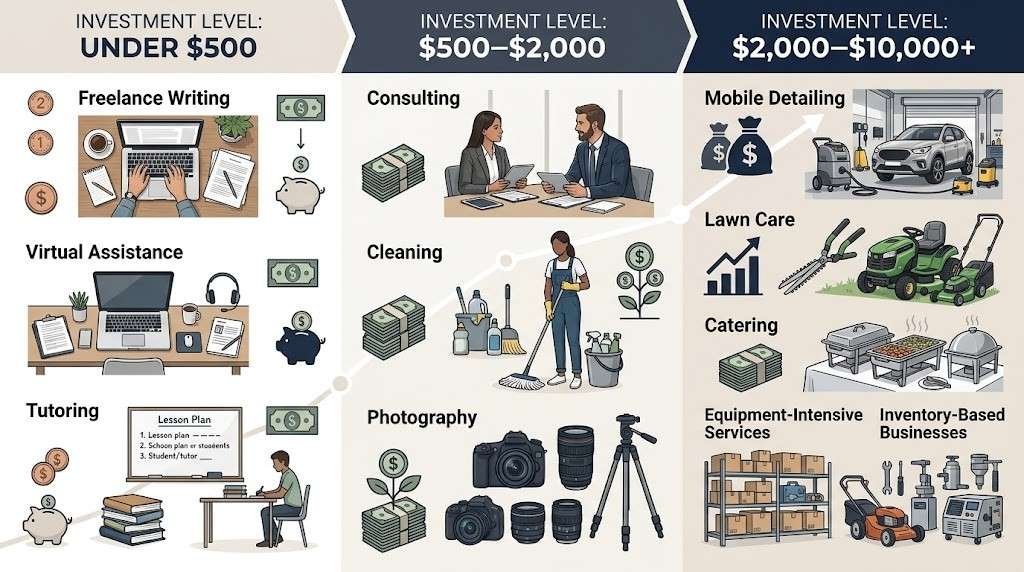
$2,000–$10,000+
Businesses that may require more capital include:
- Catering
- Equipment-intensive services
- Larger cleaning operations
- Specialized mobile services
- Inventory-based businesses
- Certain physical retail models
For a more detailed approach to business planning and startup costs, see the SBA business planning resources. The U.S. Small Business Administration explains that startup expenses can include equipment, supplies, licenses, insurance, inventory, marketing, and other costs.
Second Image: Place here, after the startup-cost section.
Alt Text: Small business ideas by startup cost
Image Title: Small Business Ideas by Startup Cost
Caption: Different business models can require very different levels of upfront investment.
Best Home-Based Business Ideas
A home-based business can reduce some overhead expenses, but it does not automatically mean zero startup costs.
Potential options include:
- Freelance writing
- Web design
- SEO services
- Graphic design
- Online tutoring
- Virtual assistance
- Consulting
- Digital products
- Handmade products
- Online reselling
If you’re specifically interested in working from home, see our guide to small business ideas you can start from home.
Best Low-Cost Small Business Ideas
If you have limited capital, service businesses can be a practical starting point because you may be able to sell your skills before investing heavily in inventory or equipment.
Consider:
- Freelancing
- Tutoring
- Virtual assistance
- Consulting
- SEO
- Social media management
- Cleaning
- Pet care
- Digital products
You can explore more low-cost business opportunities before making your decision.
Best Small Business Ideas for Different Types of Entrepreneurs
For Beginners
Beginners may want to start with a simple service where the initial investment and operational complexity are manageable.
Examples include cleaning, tutoring, freelancing, pet care, and virtual assistance.
For People Working From Home
Online and home-based businesses can offer greater flexibility.
Examples include writing, design, SEO, consulting, tutoring, and digital products.
For People With Limited Capital
Prioritize businesses where your skills and time are more important than expensive inventory or equipment.
For Professionals
Professional skills can potentially be converted into consulting, bookkeeping, design, marketing, SEO, technology, or specialized freelance services.
For Side Hustlers
Choose a model that can operate around your existing schedule. Freelancing, tutoring, digital products, reselling, and local appointment-based services can offer different levels of flexibility.
For Women Entrepreneurs
There is no single type of business that is appropriate for every woman. The best option depends on individual skills, resources, goals, schedule, and market.
You can explore more options in our guide to small business ideas for women.
For Teens
Teen entrepreneurs can explore age-appropriate activities such as tutoring, lawn care, creative services, pet care, or simple online projects, subject to parental support and applicable local rules.
See our guide to business ideas for teens for additional options.
Online vs. Local Small Business Ideas
Both models can work, but they operate differently.
| Factor | Online Business | Local Business |
| Location | Wider potential market | Specific geographic market |
| Customer reach | Potentially global | Usually local |
| Physical overhead | Often lower | Can be higher |
| Competition | Often intense | May depend on local market |
| Examples | SEO, writing, tutoring | Cleaning, detailing, lawn care |
| Customer interaction | Mostly digital | Often face-to-face |
If you want to explore online opportunities specifically, read our guide to online business ideas for beginners.
How to Choose the Best Small Business Idea for You
Instead of choosing an idea simply because someone says it is profitable, evaluate it against your own situation.
1. List Your Skills
Write down professional, technical, creative, communication, sales, and practical skills.
2. Identify Problems You Can Solve
Businesses succeed by solving problems or satisfying needs.
3. Consider Your Budget
Determine how much money you can afford to risk without creating financial stress.
4. Decide How Much Time You Have
A side business requires a different model from a full-time business.
5. Check Customer Demand
Find out whether your target customers actually want the product or service.
6. Study Competitors
Look at what competitors offer, how they position themselves, and what customers say about them.
7. Research Pricing
Find out what customers currently pay for comparable products or services.
8. Consider Your Location
Some businesses work particularly well in specific neighborhoods, cities, or regions.
9. Think About Long-Term Growth
Ask whether you want to remain a solo operator or eventually build a team.
10. Evaluate Personal Fit
A profitable opportunity may still be a poor choice if you dislike the work required to operate it.
For a structured decision process, read our guide on how to choose a small business idea.
How to Validate a Business Idea Before Investing Money
One of the biggest mistakes new entrepreneurs make is spending heavily before confirming that customers are willing to pay.
A simple validation process can include:
- Talk to potential customers.
- Identify their biggest problems.
- Research existing competitors.
- Check search demand.
- Review relevant social media discussions.
- Research your local market.
- Create a basic offer.
- Try to get your first customer.
- Test a small version of the product or service.
- Collect feedback.
- Improve your offer.
- Decide whether further investment makes sense.
You can learn more about this process in our guide on how to validate a business idea before investing.
How to Research the Market
Market research helps you understand the people you want to serve and the businesses already operating in the market.
Look at:
- Target customers
- Customer problems
- Market size
- Competitors
- Pricing
- Customer reviews
- Geographic demand
- Search behavior
- Industry trends
- Existing alternatives
For U.S.-focused research, the Census Bureau small business data can provide useful datasets and statistics for understanding businesses and economic activity.
How to Estimate Your Startup Costs
Separate your expenses into two categories.
One-Time Costs
Examples include:
- Equipment
- Initial inventory
- Website setup
- Furniture
- Licenses
- Initial branding
- Deposits
Recurring Costs
Examples include:
- Software
- Insurance
- Rent
- Internet
- Advertising
- Transportation
- Payroll
- Inventory replenishment
The SBA recommends identifying startup expenses before launching so you can understand how much capital your business may require.
Legal, Tax, and Business Setup
Before starting, research the rules that apply to your specific business and location.
Depending on the business, you may need to consider:
- Business structure
- Business registration
- Licenses and permits
- Tax obligations
- Insurance
- Separate business finances
- Recordkeeping
- Contracts
- Employment requirements
For U.S. businesses, the IRS small business and self-employed guidance is a useful starting point for understanding federal tax and recordkeeping responsibilities.
The IRS business tax information also covers different federal business tax categories.
Because requirements can differ between states, cities, industries, and business structures, verify the rules that apply to your situation before operating.
Common Small Business Mistakes to Avoid
Even a good idea can fail because of poor execution.
Avoid these common mistakes:
Choosing a Trend Without Research
A popular trend does not automatically mean there is a sustainable opportunity.
Ignoring Startup and Operating Costs
Revenue projections are meaningless if expenses are underestimated.
Buying Too Much Inventory
Inventory can tie up capital before you know whether customers will buy.
Copying Competitors
Instead of copying another company, understand what customers need and identify where you can provide better value.
Trying to Serve Everyone
A clear target customer can make marketing and product development easier.
Skipping Validation
Do not assume customers will buy simply because friends or family like your idea.
Ignoring Legal Requirements
Licenses, taxes, insurance, permits, and other requirements should be researched before launch.
Expecting Instant Profits
Most businesses require time to develop customers, systems, reputation, and consistent revenue.
For more examples, read our guide to small business mistakes to avoid.
A Simple 30-Day Plan to Start
You do not need to build everything on day one.
Days 1–7: Research
- Choose 2–3 possible ideas.
- Identify target customers.
- Study competitors.
- Research pricing.
- Estimate startup costs.
Days 8–14: Build Your Offer
- Choose one specific service or product.
- Define the customer problem.
- Create a simple offer.
- Decide how customers can contact or purchase from you.
Days 15–21: Test
- Contact potential customers.
- Promote your offer.
- Run a small test.
- Collect feedback.
- Adjust your pricing or offer.
Days 22–30: Review
Measure:
- Customer interest
- Leads
- Sales
- Expenses
- Feedback
- Time required
- Profit potential
Then decide whether to continue, change direction, or test another idea.
For a practical launch checklist, see our guide to the first steps to starting a small business.
Compare Small Business Ideas Before Choosing
Create a simple comparison table for your shortlisted ideas.
| Factor | Idea A | Idea B | Idea C |
| Startup cost | Low/Medium/High | Low/Medium/High | Low/Medium/High |
| Required skills | |||
| Customer demand | |||
| Competition | |||
| Time required | |||
| Profit potential | |||
| Recurring revenue | |||
| Scalability | |||
| Location requirements | |||
| Personal fit |
This approach can prevent you from choosing an idea based only on excitement.
Which Small Business Idea Is Most Likely to Work?
There is no single business that is guaranteed to be the best for everyone.
A stronger opportunity usually combines:
- A real customer problem
- Existing or learnable skills
- Affordable startup requirements
- Clear customer demand
- A realistic path to finding customers
- Sustainable operating costs
- Suitable pricing
- A business model that fits your available time and resources
The best idea for you may be completely different from the best idea for another entrepreneur.
What to Do After Choosing a Business Idea
Once you have selected an opportunity:
- Define your target customer.
- Research competitors.
- Validate demand.
- Estimate startup and recurring costs.
- Define your product or service.
- Set an initial price.
- Research legal requirements.
- Create a basic business plan.
- Find your first customers.
- Track revenue and expenses.
- Collect customer feedback.
- Improve the business over time.
The goal is not to create a perfect business before launch. The goal is to understand the opportunity, test your assumptions, and make informed decisions.
Frequently Asked Questions
What are the best small business ideas?
The best small business ideas depend on your skills, budget, customer demand, location, available time, and goals. Freelancing, tutoring, cleaning, consulting, digital products, local services, and specialized professional services are among the many models worth evaluating.
What is the easiest small business to start?
Service-based businesses are often simpler to start because they may require less inventory and physical infrastructure. Examples include freelance writing, virtual assistance, tutoring, cleaning, consulting, and certain digital services.
What is the best small business to start with little money?
Businesses based primarily on skills rather than inventory or expensive equipment can be easier to start with limited capital. Freelancing, tutoring, consulting, virtual assistance, and some digital-product businesses are examples.
What business can I start from home?
Depending on your skills and local requirements, you could consider writing, web design, SEO, graphic design, tutoring, consulting, virtual assistance, digital products, handmade products, or online reselling.
How do I know whether a business idea will be profitable?
You cannot know with certainty before launching. Research demand, competitors, pricing, startup costs, recurring expenses, customer acquisition, and margins, then validate the idea with real customers before making a large investment.
Should I start an online or local business?
It depends on your skills, target customers, preferred work style, location, and business model. Online businesses can reach wider markets, while local businesses can benefit from geographic demand and face-to-face relationships.
How do I choose the right business idea?
Start by comparing your skills, budget, available time, customer demand, competition, startup requirements, profit potential, and personal preferences. Then test your strongest idea on a small scale before committing significant money.
Final Thoughts
The best small business ideas are not simply the ones appearing on popular lists. The right opportunity is one that solves a real problem, has customers willing to pay, fits your resources, and gives you a realistic way to operate and grow.
Start with research rather than a large investment. Compare several opportunities, talk to potential customers, estimate your costs, test your offer, and learn from the results.
A small, validated business can be a stronger starting point than an ambitious idea that requires significant money before you know whether the market wants it.