
HR compliance can feel complicated for a small business because there is no single law, agency, or checklist that covers every employer.
Requirements can depend on the number of employees you have, where they work, how they are classified, what your business does, and which federal, state, and local rules apply.
That means HR compliance is not simply about downloading an employee handbook or checking a few boxes once a year. It is an ongoing process of making sure your hiring, pay, records, policies, workplace practices, and employee-management processes are handled consistently.
For small businesses without a dedicated HR department, the most practical approach is to organize compliance around the employee lifecycle and regularly review the areas where requirements can change.
What Is HR Compliance?
HR compliance means following the employment-related laws, regulations, and applicable workplace requirements that affect how a business hires, pays, manages, and separates employees.
It can involve areas such as:
- Hiring and employment eligibility
- Worker classification
- Wages and working time
- Payroll taxes
- Employee records
- Workplace policies
- Anti-discrimination requirements
- Leave and accommodations
- Workplace safety
- Benefits
- Employee complaints
- Termination and final-pay procedures
Not every requirement applies to every business.
For example, federal employment-discrimination laws enforced by the EEOC have employee-count thresholds, and state or local laws can impose additional requirements. The EEOC specifically advises small businesses to determine which federal, state, and local requirements apply to them rather than assuming every rule applies in the same way.
That is why a good compliance process starts with identifying the rules relevant to your business rather than copying another company’s checklist.
Why HR Compliance Matters for Small Businesses
Small businesses often have fewer people available to review HR processes.
One owner may be responsible for hiring, payroll coordination, employee questions, and management decisions. An office manager may maintain employee records while managers handle performance issues.
That can create gaps even when everyone is acting in good faith.
Common problems include:
- Missing or incomplete employee records
- Incorrect worker classification
- Inconsistent timekeeping
- Outdated workplace policies
- Incomplete new-hire documentation
- Unclear leave procedures
- Poor documentation of employee issues
- Inconsistent disciplinary practices
- Missed payroll or tax requirements
- Policies that do not reflect current operations
The goal of HR compliance is therefore not simply to avoid penalties. It is to create repeatable processes that help the business handle employees consistently.
1. Hiring and New-Hire Compliance
Compliance begins before or when someone joins the company.
A small business should have a consistent process for hiring and onboarding employees.
That process can include:
- Job descriptions
- Consistent application and interview procedures
- Employment documentation
- Worker classification
- Employment eligibility verification
- Required state or local new-hire reporting
- Payroll setup
- Required workplace notices
- Employee handbook or policy acknowledgment
- Benefits enrollment where applicable
Form I-9
Every newly hired employee must complete Form I-9 to establish identity and employment authorization. USCIS explains that both the employee and employer have responsibilities in completing the form.
Businesses should use the current official form and follow the applicable USCIS instructions rather than relying on an old template saved in a shared folder.
The important lesson is that onboarding compliance should be treated as a process, not as a collection of unrelated forms.
2. Worker Classification
Worker classification is another area that deserves regular attention.
A business may have employees, independent contractors, or other types of workers. The correct classification can affect tax treatment, wage-and-hour obligations, benefits, and other responsibilities.
The IRS explains that businesses must determine whether a worker is an employee or an independent contractor because the tax responsibilities differ.
A practical review should ask:
- Who controls how the work is performed?
- What type of relationship exists?
- How is the worker paid?
- Is the arrangement ongoing or project-based?
- What does the applicable federal or state test say?
- Has the relationship changed since the person was originally classified?
Do not classify someone as an independent contractor simply because the business uses a contractor agreement or issues a particular tax form. The applicable legal tests matter.
3. Wage and Hour Compliance
Payroll accuracy is an important part of HR compliance.
Businesses should review:
- Employee pay rates
- Exempt and nonexempt classifications
- Hours worked
- Overtime
- Timekeeping
- Deductions
- Required wage notices
- Applicable minimum-wage rules
- State and local wage requirements
The Fair Labor Standards Act has federal requirements for covered employers, including recordkeeping related to wages and hours. The Department of Labor says covered employers generally must preserve certain payroll records for at least three years, while records supporting wage computations generally must be retained for two years.
State and local rules can add requirements, so a small business should not assume that meeting the federal minimum automatically satisfies every applicable obligation.
4. Payroll and Employment Taxes
HR compliance overlaps with payroll compliance.
Employers generally have federal responsibilities involving income-tax withholding, Social Security and Medicare taxes, unemployment taxes, payroll reporting, and related records. The IRS provides specific employer guidance for depositing and reporting employment taxes.
A business should establish clear ownership for:
- Payroll processing
- Time approval
- Employee tax forms
- Payroll-tax deposits
- Payroll-tax filings
- W-2 reporting
- Corrections
- Payroll record retention
Using payroll software can reduce administrative work, but software does not automatically make every employment decision compliant.
Someone still needs to verify that employee information, pay classifications, hours, deductions, and other inputs are correct.
5. Employee Records and Documentation
Good HR compliance depends heavily on documentation.
Businesses should know what records they maintain, where those records are stored, who can access them, and how long they must be retained.
Depending on the record and applicable law, documentation can include:
- Employee identification information
- Employment documents
- Payroll records
- Time records
- Tax forms
- Performance documentation
- Leave records
- Policy acknowledgments
- Training records
- Employee complaints
- Investigation documentation
- Termination records
The IRS requires employers to retain employment-tax records for at least four years after filing the relevant fourth-quarter return. Other employment records can have different retention periods under different laws.
This is why a single folder called “Employee Records” is not necessarily an adequate records-management system.
6. Employee Handbook and Workplace Policies
A handbook can help communicate workplace expectations, but it should not be treated as a one-time document.
Review whether your policies still reflect how the company actually operates.
Common areas include:
- Equal employment opportunity
- Anti-harassment
- Workplace conduct
- Attendance
- Working hours
- Remote or hybrid work
- Paid time off
- Leave
- Workplace technology
- Confidentiality
- Expense policies
- Performance management
- Discipline
- Complaint reporting
The EEOC advises small businesses to develop anti-discrimination policies, address harassment, provide required accommodations where applicable, protect employees from retaliation, and maintain employment records as required by law.
A policy is only useful if employees and managers know it exists and the business actually follows it.
7. Anti-Discrimination and Equal Employment Practices
Federal employment-discrimination requirements depend partly on employer size, and additional state and local laws may apply.
The EEOC states that businesses with at least 15 employees are generally covered by most federal employment-discrimination laws it enforces, while the Age Discrimination in Employment Act generally applies at 20 or more employees. The Equal Pay Act has broader coverage.
Businesses should review whether employment decisions are being made consistently across:
- Hiring
- Pay
- Promotion
- Discipline
- Training
- Termination
- Workplace accommodations
Managers should also know how to respond when an employee raises a discrimination or harassment concern.
The purpose is not to create unnecessary bureaucracy. It is to make important employment decisions based on legitimate, documented factors rather than inconsistent treatment.
8. Leave and Accommodation Processes
Leave and accommodation requirements can vary considerably depending on the applicable law, employee count, location, and circumstances.
A small business should have a process for receiving and responding to employee requests rather than handling each request differently.
That process should identify:
- Who receives the request
- How the request is documented
- What information may be requested
- Who reviews the situation
- How decisions are communicated
- What records are maintained
- When outside professional advice is needed
Do not rely on a generic PTO policy to answer every leave or accommodation question.
Some employee situations involve federal, state, or local requirements that go beyond the company’s ordinary vacation policy.
9. Workplace Safety
HR compliance also intersects with workplace safety.
The applicable requirements depend on the workplace and industry, but employers should have a process for identifying workplace hazards, communicating safety expectations, handling incidents, and maintaining required records where applicable.
This becomes particularly important for businesses with physical workplaces, equipment, vehicles, manufacturing operations, construction activity, or other higher-risk environments.
Safety should therefore be treated as an operating process rather than something reviewed only after an accident.
10. Employee Complaints and Investigations
Small businesses should decide in advance how employee complaints will be handled.
A practical process should answer:
- Where can employees report concerns?
- Who receives the complaint?
- Who decides whether an investigation is needed?
- How will information be documented?
- Who needs to know?
- How will confidentiality be handled?
- What happens after the investigation?
- How will retaliation concerns be addressed?
Not every complaint requires the same response.
However, having no defined process can lead to inconsistent handling, incomplete documentation, or unnecessary delays.
11. Performance Management and Discipline
Performance management is another area where informal practices can create problems as a business grows.
Managers should understand:
- What performance standards apply
- How concerns should be communicated
- What documentation is expected
- When HR should be involved
- How improvement plans work
- How disciplinary decisions are made
- How similar situations should be handled consistently
The objective is not to document every conversation unnecessarily.
Instead, important employment decisions should have enough accurate documentation to explain what happened, what expectations were communicated, and how the business responded.
12. Termination and Offboarding
HR compliance does not end when an employee leaves.
A consistent offboarding process can cover:
- Termination documentation
- Final-pay requirements
- Benefits information
- Return of company property
- Access removal
- Record updates
- Exit documentation
- Required notices
- Unemployment-related responses where applicable
Final-pay and separation requirements can vary by state, so businesses should verify the applicable rules rather than using one process for every location.
Federal, State, and Local Rules: Why Location Matters
One of the biggest mistakes a small business can make is assuming that federal requirements are the complete HR compliance picture.
They are not.
A business can face requirements from:
Federal government: Agencies such as the Department of Labor, EEOC, IRS, USCIS, and OSHA oversee different areas.
State government: States can establish their own wage, leave, employment, notice, privacy, and other workplace requirements.
Local government: Some cities and counties impose additional employment requirements.
The applicable rules can also change when a company hires employees who work in another state.
That means a business with employees in three states may have a more complicated compliance environment than a larger business operating entirely in one location.
A Practical Small Business HR Compliance Checklist
Use the following as a starting point for an internal review:
Hiring
- Job descriptions are current
- Hiring practices are consistent
- Worker classification has been reviewed
- Form I-9 process is current
- Required new-hire reporting is handled
- Payroll setup is completed correctly
Pay and Payroll
- Pay rates are documented
- Exempt/nonexempt classifications have been reviewed
- Timekeeping is accurate where required
- Overtime is handled correctly
- Payroll taxes are deposited and reported
- Payroll records are retained appropriately
Policies
- Employee handbook is current
- Anti-discrimination policy is established
- Harassment concerns have a reporting process
- Leave policies reflect applicable requirements
- Remote-work policies are current if relevant
- Employees know where to find policies
Employee Records
- Personnel records are organized
- Payroll records are maintained
- Required employment records are retained
- Sensitive information has appropriate access controls
- Former employee records are handled according to applicable retention rules
Employee Management
- Performance expectations are documented
- Managers know how to handle employee concerns
- Complaints have a defined escalation process
- Disciplinary practices are consistent
- Termination procedures are documented
Workplace
- Required workplace notices are available
- Safety processes are appropriate for the workplace
- Workplace incidents are documented where required
- State and local requirements have been reviewed
How Often Should a Small Business Review HR Compliance?
There is no universal schedule that covers every HR requirement.
A better approach is to combine regular reviews with event-based reviews.
Monthly
Check operational items such as:
- Payroll issues
- New hires
- Employee documentation
- Open employee concerns
- Policy exceptions
Quarterly
Review:
- Worker classifications
- Employee records
- Policy implementation
- Manager practices
- Outstanding HR issues
Annually
Conduct a broader HR compliance review covering:
- Handbook and policies
- Employment classifications
- Required notices
- Recordkeeping
- Payroll processes
- Training
- State and local requirements
After a Major Change
Review compliance whenever the business:
- Enters a new state
- Opens another location
- Significantly increases hiring
- Changes payroll systems
- Changes benefits
- Introduces remote work
- Restructures teams
- Acquires another company
This event-based approach is often more useful than waiting for one annual checklist exercise.
How to Find HR Compliance Gaps
A useful compliance review should not simply ask, “Do we have a policy?”
Ask three additional questions:
Does the policy match what we actually do?
A handbook may say one thing while managers follow another process.
Can we prove the process was followed?
A business may have a policy but no documentation showing that employees received it or that managers followed the required procedure.
Who owns the process?
If nobody is responsible for reviewing an obligation, it can quietly become outdated.
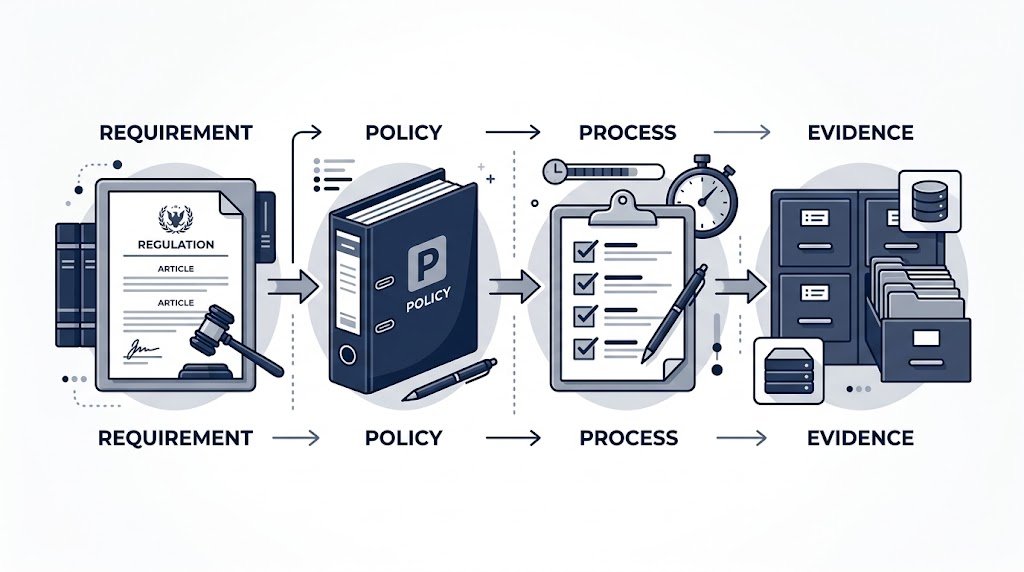
This creates a simple four-part test:
Requirement → Policy → Process → Evidence
If one of those pieces is missing, investigate the gap.
Common HR Compliance Mistakes
Small businesses frequently run into trouble because of process weaknesses rather than intentional violations.
Watch for these warning signs:
Using old templates
Employment requirements change, but documents often remain untouched for years.
Treating contractors like employees
A contractor agreement alone does not determine classification.
Keeping everything in one folder
Different records can have different access and retention requirements.
Letting every manager handle issues differently
Inconsistent practices can create unnecessary risk and confusion.
Assuming payroll software handles everything
Software can process information, but it does not determine whether the underlying HR decisions are correct.
Ignoring state requirements
Federal compliance is only one layer of the employment-law framework.
Waiting for a problem before reviewing policies
A proactive review is generally easier than rebuilding HR processes during a dispute.
When Should a Small Business Get Professional HR Help?
Not every business needs a full-time HR professional.
However, outside HR support may become useful when:
- HR responsibilities are consuming significant management time
- The company is hiring rapidly
- Managers need regular employee-relations guidance
- Policies have not been reviewed recently
- The workforce spans multiple states
- Employee issues are becoming more complicated
- The business is restructuring or expanding
- Leadership wants a formal HR compliance review
A business may choose project-based HR consulting for a specific audit or policy project, while recurring HR needs may make fractional HR support more appropriate.
For businesses evaluating that decision, understanding fractional HR for small businesses can help clarify the difference between occasional consulting and ongoing HR support.
You can also review when a small business should hire an HR consultant if the main question is whether professional HR support is needed at this stage.
A Simple 30-Day HR Compliance Review
A small business does not need to rebuild its entire HR system in one weekend.
A practical first month can look like this:
Week 1: Identify
List your employees, locations, worker classifications, HR systems, policies, and major HR processes.
Week 2: Review
Check hiring documents, payroll practices, employee records, handbook policies, and manager procedures.
Week 3: Prioritize
Separate findings into:
Urgent: Issues that may require immediate professional or legal attention.
Important: Process gaps that should be corrected soon.
Routine: Improvements that can be scheduled.
Week 4: Assign
Give every major compliance process an owner and establish when it will next be reviewed.
This turns HR compliance from a vague responsibility into a manageable operating system.
Final Thoughts
HR compliance for small businesses is not about memorizing every employment law.
It is about knowing which requirements apply to your business, assigning responsibility for them, maintaining accurate records, keeping policies current, and reviewing processes when the business or legal environment changes.
The most useful compliance system is one that employees and managers can actually follow.
Start with the fundamentals: hiring, worker classification, pay, payroll, records, policies, workplace practices, employee concerns, and offboarding. Then add the state and local requirements that apply to your locations and workforce.
And when a situation involves a complex legal question, treat HR guidance and legal advice as different functions. A qualified HR professional can help organize processes and manage people operations, while employment counsel can address matters requiring legal advice.
The objective is not to create paperwork for its own sake. It is to build an HR system that is current, documented, consistently applied, and appropriate for the business you actually operate.