
Small businesses often handle HR without a dedicated HR professional. The owner may manage hiring, an office manager may maintain employee records, and payroll may be handled through accounting software or an outside provider. That arrangement can work when the workforce is small and HR needs are straightforward.
The question is not simply how many employees you have. A better question is whether your business has reached a point where HR decisions are becoming too time-consuming, complicated, sensitive, or risky to manage without specialized support.
Here are the clearest situations that can indicate it is time to consider an HR consultant.
1. HR Is Taking Too Much of Your Time
One of the earliest signs is not an employee count. It is the amount of management time being consumed by HR work.
If you are regularly spending hours on:
- Employee questions
- Hiring and onboarding
- Performance issues
- Policies and documentation
- Leave and attendance matters
- Employee records
- Workplace conflicts
- Terminations or disciplinary situations
HR may be competing with the work you actually need to do to run the business.
An HR consultant can help identify which responsibilities should be handled internally, which processes need improvement, and where specialized support would save management time.
2. You Are Hiring More Employees Than Before
Rapid hiring can expose weaknesses in informal HR processes.
When you only have a few employees, you may be able to handle hiring through personal conversations and simple paperwork. As hiring becomes more frequent, however, consistency becomes more important.
You may need clearer processes for:
- Writing job descriptions
- Screening candidates
- Conducting interviews
- Preparing offers
- Completing onboarding
- Explaining workplace policies
- Managing employee records
This does not automatically mean you need a full-time HR employee. A consultant can help build the system while your business continues to manage day-to-day operations.
3. You Are Unsure Whether Your HR Policies Are Appropriate
An outdated or incomplete employee handbook can create confusion about workplace expectations.
The same applies to policies covering areas such as attendance, workplace conduct, leave, performance management, remote work, and disciplinary procedures.
If you are unsure whether your existing policies reflect your current workforce and applicable requirements, an HR consultant can conduct a review and identify areas that need attention.
For businesses operating in multiple states, the challenge can become more complicated because employment requirements may differ by location.
4. Employee Problems Are Becoming More Complicated
Small businesses do not need hundreds of employees to encounter difficult HR situations.
A single employee complaint, performance problem, conflict between employees, or termination can require careful handling.
For example, a manager might ask:
- How should this performance issue be documented?
- Should the employee receive a warning?
- How should a complaint be investigated?
- What information should be kept in the employee record?
- How should the company communicate a termination?
- When should an employment attorney be involved?
An HR consultant can provide HR process guidance and help management approach sensitive situations consistently.
A consultant is not a substitute for an employment attorney when a matter requires legal advice. In higher-risk situations, businesses may need both HR and legal professionals.
5. Managers Are Handling People Issues Inconsistently
As a business grows, more employees usually means more managers or team leaders.
That creates another HR challenge: different managers may handle similar situations differently.
One manager might document performance problems carefully while another handles everything informally. One might apply a company policy consistently while another makes exceptions.
Inconsistency can create confusion and make workplace decisions harder to defend.
An HR consultant can help establish clearer procedures, manager guidelines, documentation practices, and expectations for handling common employee situations.
6. You Are About to Make a Major Business Change
An HR consultant can also be useful before a significant organizational change rather than after a problem occurs.
Examples include:
- Rapid expansion
- Opening another location
- Hiring employees in another state
- Restructuring teams
- Introducing new management layers
- Acquiring another business
- Changing compensation structures
- Creating formal performance systems
The purpose is not simply to have someone “handle HR.” It is to make sure the people-related side of the change is planned instead of becoming an afterthought.
7. Your Business Is Growing Beyond Informal HR Processes
There is no universal employee number at which every small business suddenly needs an HR consultant.
Some businesses can operate effectively with informal HR processes for years. Others need professional HR support much earlier because of their industry, workforce structure, geographic footprint, or hiring activity.
Headcount can therefore be a useful signal, but it should not be the only measurement.
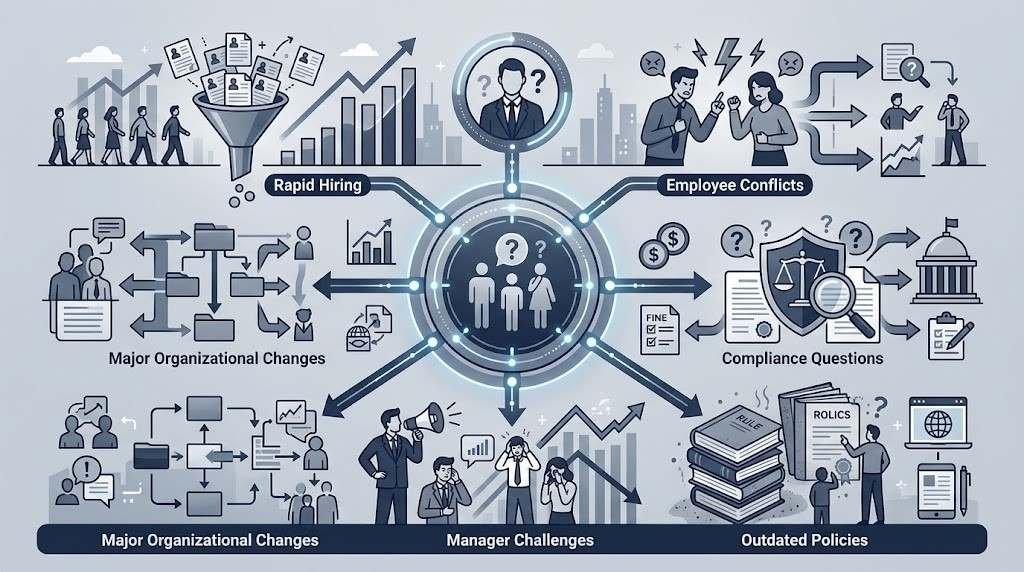
A better assessment considers three things:
People volume: How many employees, managers, hires, and employee situations are you handling?
HR complexity: How complicated are your policies, workforce structure, locations, and employee issues?
Management capacity: How much time can your leadership team realistically devote to HR?
When all three are increasing, outside HR support may become more valuable.
8. You Need an HR Project but Not a Full-Time Employee
Not every HR need requires an ongoing relationship.
You might need professional help for one specific project, such as:
- Creating an employee handbook
- Reviewing HR policies
- Building an onboarding process
- Conducting an HR audit
- Improving performance documentation
- Developing job descriptions
- Preparing HR processes for expansion
In these situations, a project-based consultant may make more sense than creating a permanent HR position.
If HR needs continue every week, however, you may want to consider fractional HR support for small businesses instead.
9. You Are Spending Money on HR Mistakes or Inefficiency
The cost of HR problems is not always an obvious legal expense.
Poor processes can also lead to:
- Repeated hiring mistakes
- Slow onboarding
- Management time being wasted
- Employee turnover
- Inconsistent documentation
- Delayed responses to employee concerns
- Rework caused by unclear policies
Before hiring a consultant, identify the actual problem.
For example, if your managers spend several hours every week answering questions that could be resolved through better policies and documentation, the underlying issue may be an HR process gap rather than a lack of staff.
When You May Not Need an HR Consultant
Hiring an HR consultant is not automatically the right answer for every small business.
You may not need ongoing consulting if:
- Your team is very small and stable
- Hiring is infrequent
- HR administration is manageable
- Your policies are current and well documented
- Managers understand their responsibilities
- Employee issues are relatively straightforward
- You already have appropriate HR software or support
You can also use targeted professional help instead of committing to ongoing HR consulting.
The goal should be to solve a specific business need rather than hire HR support simply because another company did.
HR Consultant vs. Full-Time HR Employee
Another important question is whether you need a consultant or an internal HR employee.
A consultant can be useful when your HR needs are project-based, specialized, variable, or not large enough to justify a dedicated position.
A full-time HR employee may become more appropriate when HR work is continuous and substantial enough to require dedicated daily ownership.
There is also a middle option: fractional HR.
Fractional HR provides recurring HR expertise for a limited amount of time rather than creating a full-time internal position.
The right model depends on workload, complexity, budget, and how much responsibility your business needs the HR professional to own.
How to Decide If the Timing Is Right
Instead of asking, “How many employees should we have before hiring an HR consultant?” ask these questions:
- How many hours does management spend on HR each month?
- Are employee issues becoming more complicated?
- Are we hiring frequently enough to need a consistent process?
- Are our policies current and appropriate for our workforce?
- Do managers know how to handle performance and employee issues?
- Are we expanding into new locations or states?
- Do we have an upcoming HR project that requires specialized expertise?
- Would better HR processes save meaningful management time?
- Do we need occasional advice, a defined project, or ongoing support?
- Would a consultant solve a specific problem we can clearly identify?
If the answers show that HR is becoming a recurring operational challenge, it may be time to evaluate professional support.
Before comparing providers, it is also useful to understand evaluating HR consulting options for a small business so you can compare experience, scope, pricing, and engagement models rather than choosing based only on an advertised hourly rate.
Final Thoughts
There is no single employee-count threshold that determines when a small business should hire an HR consultant.
The stronger indicators are usually workload, complexity, business growth, employee relations, policy gaps, and management capacity.
A consultant can be useful before a serious HR problem develops, during a period of rapid growth, or for a defined project that requires expertise your business does not have internally.
The best time to consider HR support is when you can identify a genuine business need and match the engagement to that need—whether that means a one-time project, occasional advice, fractional support, or eventually a full-time HR role.