


For a small business, human resources rarely starts as a separate department. Hiring may be handled by the owner, employee questions may go to an office manager, and workplace policies may be created only when a situation requires them.
That approach can work for a while. As the team grows, however, HR responsibilities become more complicated. An HR consultant for a small business can provide specialized expertise without requiring the company to immediately hire a full-time HR professional.
The consultant’s role can range from fixing a specific HR problem to building processes that support employees throughout their time with the company.
What Is an HR Consultant?
An HR consultant is an external professional who helps a business manage human resources processes, employee-related issues, and workplace practices.
Unlike an in-house HR manager, a consultant does not necessarily work full time for one company. A small business might use a consultant for a defined project, occasional advice, ongoing support, or a fractional HR arrangement.
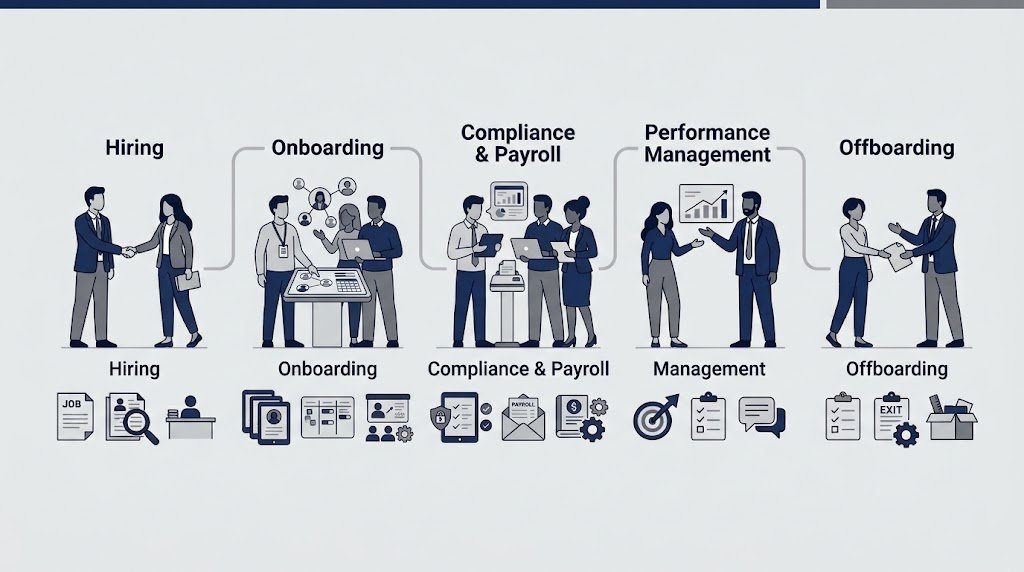
The scope varies. Some consultants concentrate on compliance and policies, while others provide broader assistance with recruiting, onboarding, employee relations, performance management, HR systems, and workforce planning.
The important question is not simply what services a consultant advertises. It is what business problem the consultant can help solve and what will actually be delivered.
What Does an HR Consultant Do for a Small Business?
1. Builds a More Consistent Hiring Process
Hiring can become inconsistent when every manager uses a different approach.
An HR consultant may help create:
- Clear job descriptions
- Interview processes
- Candidate evaluation criteria
- Hiring workflows
- Offer procedures
- New-hire documentation
- Recruiting guidelines
The objective is to make hiring more organized and repeatable rather than leaving every decision to individual managers.
For New Jersey employers, hiring also needs to fit applicable state and federal requirements. The state’s business guidance covers employer responsibilities related to hiring, worker classification, registration, and other employment matters.
2. Improves Employee Onboarding
Hiring an employee is only the beginning.
A consultant can create an onboarding process that explains the employee’s role, responsibilities, workplace expectations, policies, documentation, and initial training.
A practical onboarding system might include:
Before the first day: paperwork, access, equipment, schedule, and introductions.
First week: orientation, policies, job expectations, and manager check-ins.
First 30–90 days: training, feedback, performance expectations, and follow-up.
Current small-business HR providers commonly include onboarding and offboarding as part of their ongoing support.
3. Creates and Reviews HR Policies
A business does not need a policy for every imaginable situation, but employees and managers need clear expectations.
An HR consultant may develop or review policies covering:
- Workplace conduct
- Attendance
- Leave
- Remote work
- Technology use
- Performance expectations
- Confidentiality
- Employee complaints
- Disciplinary procedures
The consultant can also review whether written policies match the company’s actual practices.
For New Jersey businesses, this is particularly relevant because employers need to account for applicable state requirements alongside federal obligations. New Jersey’s official employer resources cover areas including wage and hour rules, leave, worker classification, unemployment, and workers’ compensation.
4. Supports Employee Relations
Employee relations can consume a disproportionate amount of a small-business owner’s time.
An HR consultant may help management approach:
- Workplace conflicts
- Employee complaints
- Performance concerns
- Corrective action
- Difficult conversations
- Grievances
- Workplace investigations
- Documentation
The consultant’s role is generally to help establish a fair and consistent process. The business remains responsible for its management decisions.
When an issue involves potential litigation or requires legal interpretation, an employment attorney should be involved.
5. Establishes Better Performance Management
Many small businesses do not have a formal performance-review system.
An HR consultant can help managers create a practical process around:
- Setting clear expectations
- Giving employees regular feedback
- Documenting performance concerns
- Establishing improvement goals
- Scheduling follow-up conversations
- Determining appropriate next steps
This gives managers a framework for addressing problems before they become larger workplace issues.
6. Reviews HR Compliance and Documentation
Compliance support is one of the areas where outside HR expertise can be particularly useful.
An HR review may examine:
- Employee records
- Handbook policies
- Worker classifications
- Onboarding documentation
- Leave procedures
- Required notices
- Payroll-related HR processes
- Performance and disciplinary documentation
Current small-business HR providers increasingly package these reviews as HR audits or risk assessments, often producing a prioritized list of areas requiring attention.
The distinction between HR guidance and legal advice matters here. An HR consultant can help identify process gaps, but an attorney should handle legal advice and representation.
What Does an HR Consultant Actually Deliver?
This is one of the most important questions to ask before hiring one.
Depending on the engagement, the deliverables might include:
- Employee handbook
- Updated HR policies
- Hiring workflow
- Onboarding checklist
- HR forms
- Personnel-file review
- Compliance assessment
- Manager training
- Performance-management framework
- HR process documentation
- HR technology recommendations
- Ongoing advisory access
Do not assume that a service name tells you what you will receive. A proposal should clearly explain the work, deliverables, responsibilities, timeline, and fees.
Does an HR Consultant Handle Payroll?
Sometimes, but not always.
Some HR consultants help coordinate payroll processes or work alongside a payroll provider. Others focus entirely on people management, compliance, policies, and employee relations.
Payroll processing, tax filings, benefits administration, and HR consulting can be separate functions even when one provider offers several of them.
Before signing an agreement, ask exactly which payroll responsibilities are included and which remain with your business or payroll provider.
HR Consultant vs. HR Manager
An HR manager is an internal employee who works within the company’s organization and usually handles HR responsibilities as an ongoing part of the job.
An HR consultant is an external professional brought in for specialized or continuing support.
A small business might choose consulting when it needs expertise but does not yet need a full-time HR position. A larger or rapidly growing company may eventually bring HR in-house while continuing to use consultants for specialized projects.
The right arrangement depends on workload, complexity, budget, and how frequently HR support is needed.
HR Consultant vs. Employment Lawyer
These professionals should not be treated as interchangeable.
An HR consultant generally helps with HR processes, employee management, documentation, policies, training, and workplace practices.
An employment lawyer provides legal advice and representation.
For example, an HR consultant might help a manager structure a performance process and document employee communications. If the company faces a legal claim or needs legal interpretation, an employment attorney may be necessary.
Knowing the difference can prevent a business from expecting one professional to perform the other’s role.
HR Consultant vs. Recruitment Agency
A recruitment agency generally focuses on finding candidates for specific vacancies.
An HR consultant can work across the wider employee lifecycle, including hiring processes, onboarding, policies, performance management, employee relations, compliance processes, and HR strategy.
A company can use both. A recruiter may help find a candidate while an HR consultant improves the company’s overall hiring and onboarding system.
How Does an HR Consultant Work With a Small Business?
There is no single engagement model.
Project-Based Consulting
Useful for a defined task such as an employee handbook, HR audit, policy review, or onboarding redesign.
Hourly Consulting
Suitable when the business needs occasional advice or assistance with individual HR questions.
Monthly Retainer
Provides continuing access to HR support under an agreed scope and fee.
Fractional HR
Provides ongoing part-time HR expertise without creating a full-time HR position.
Businesses considering this model can learn more through BusinessNexa’s guide to fractional HR support for small businesses.
For a broader look at selecting HR support in New Jersey, see our guide to evaluating HR consulting options for a small business.
When Is an HR Consultant Worth Considering?
A consultant may be worth exploring when:
- HR tasks are taking management away from core business work
- Hiring has become more frequent
- Employee documentation is inconsistent
- Policies have not been reviewed recently
- Managers need help handling employee issues
- Performance problems are becoming harder to manage
- The company is unsure whether its HR processes are adequate
- The business needs HR expertise but not a full-time HR department
New Jersey businesses should also pay attention to state-specific requirements. The state provides employer resources covering areas such as employee classification, wage and hour requirements, leave, unemployment, and workers’ compensation.
Worker classification is one example where current information matters. New Jersey adopted regulations in 2026 clarifying the ABC test, with the new rules scheduled to become operative on October 1, 2026.
How to Evaluate an HR Consultant
Before choosing a consultant, ask questions that reveal how the engagement will work in practice.
What businesses do you normally support?
Experience with companies similar to yours can be more useful than a long list of generic services.
What exactly is included?
Ask for specific deliverables rather than accepting broad descriptions such as “full HR support.”
Who will actually work with us?
The person selling the service may not be the person providing it.
How are urgent employee issues handled?
This matters if you are purchasing ongoing support.
How do you keep your guidance current?
Employment requirements can change, so ask how updates are monitored.
When do you recommend legal counsel?
A responsible HR consultant should understand the boundary between HR guidance and legal advice.
What happens as the company grows?
Your HR requirements may change significantly as employee numbers and business complexity increase.
Final Thoughts
An HR consultant can help a small business turn informal people management into more structured, repeatable processes.
The work may include hiring, onboarding, policies, employee relations, performance management, documentation, compliance reviews, training, HR administration, or strategic planning. The consultant may work on one project or become an ongoing part-time HR resource.
For New Jersey businesses, understanding state-specific employment requirements is an additional consideration when evaluating HR support. A consultant can help organize HR processes and identify areas that need attention, while employment attorneys remain the appropriate resource for legal advice and representation.
The best starting point is to identify the specific HR problem first. Once the business knows what needs to be solved, it becomes much easier to choose the right type of consultant, engagement model, and scope of work.