
Best Businesses to Start in India with Low Investment
Starting a business in India does not always require a large amount of money, a commercial office, or a team […]


Starting a business in India does not always require a large amount of money, a commercial office, or a team of employees. Many entrepreneurs begin with a professional skill, a small workspace, or a product they can make and sell from home.
Some of the best low-investment business opportunities include online tutoring, freelance services, social media management, home-based food businesses, tailoring, mobile repair, and online reselling. These ideas can be tested on a small scale before investing in expensive equipment, inventory, or premises.
However, a low startup cost does not guarantee profitability. The right opportunity depends on your skills, customer demand, competition, pricing, and ability to manage daily expenses.
This guide explores 15 businesses you can consider starting in India with a limited budget. It also explains their basic requirements, approximate starting costs, and practical ways to find your first customers.
15 Best Businesses to Start in India with Low Investment
The following business ideas cover digital services, home-based products, and local services. Their estimated budgets are illustrative planning ranges, not verified market averages or guaranteed setup costs. Actual expenses will depend on your city, existing equipment, product quality, workspace, and business model.
| Business idea | Indicative starting budget | Suitable for |
|---|---|---|
| Online tutoring | ₹5,000–₹25,000 | Teachers and subject specialists |
| Freelance writing and graphic design | ₹5,000–₹40,000 | Writers and creative professionals |
| Social media management | ₹10,000–₹40,000 | Digital marketing beginners |
| Video editing services | ₹15,000–₹60,000 | Editors and content creators |
| Home-based tiffin service | ₹20,000–₹70,000 | Home cooks |
| Home bakery | ₹25,000–₹90,000 | Bakers and food entrepreneurs |
| Tailoring and alterations | ₹15,000–₹60,000 | Skilled tailors |
| Mobile phone repair | ₹30,000–₹1.2 lakh | Technically trained individuals |
| Home and office cleaning | ₹15,000–₹50,000 | Local service operators |
| Event and balloon decoration | ₹20,000–₹75,000 | Creative planners |
| Personalized gifts | ₹20,000–₹80,000 | Craft makers and online sellers |
| Online product reselling | ₹10,000–₹50,000 | First-time sellers |
| Bookkeeping services | ₹10,000–₹45,000 | Accounting professionals |
| Product photography | ₹25,000–₹1 lakh | Photographers and creators |
| Homemade pickles, spices, and snacks | ₹25,000–₹1 lakh | Food entrepreneurs |
These estimates may exclude rent deposits, salaries, vehicles, major machinery, and substantial inventory. If you already own a computer, sewing machine, kitchen equipment, or other necessary tools, your initial costs may be lower.
1. Online Tutoring and Coaching
Online tutoring can be a practical business for people who understand a subject and can explain it clearly. Students and parents look for help with school subjects, entrance exam preparation, languages, computer skills, and professional learning.
You can begin with individual online classes using a laptop or smartphone, a stable internet connection, and suitable teaching materials.
How to start:
- Choose one subject or student group.
- Prepare a sample lesson to demonstrate your teaching style.
- Offer individual sessions or small group classes.
- Set clear class timings and payment arrangements.
- Ask satisfied students for referrals.
For example, a mathematics graduate could offer evening lessons to students preparing for school examinations. Once the number of students increases, the tutor could introduce group batches or recorded lessons.
The main challenge is establishing trust. Students and parents need to see that your teaching is understandable, consistent, and useful.
2. Freelance Writing and Graphic Design
Businesses need written and visual content for websites, product pages, advertisements, presentations, social media, and email campaigns. People with writing, editing, or design skills can turn these needs into a small service business.
Possible services include:
- Blog articles and website content
- Product descriptions
- Social media graphics
- Business presentations
- Brochures and promotional material
- Basic website content editing
You can begin with a computer, internet access, and suitable software. A portfolio containing a few strong sample projects will help potential clients understand your abilities.
Instead of offering every possible creative service, start with a specific customer group or deliverable. For example, a freelance writer could focus on website content for small businesses, while a designer could specialize in promotional graphics for local retailers.
Reliable communication, original work, subject knowledge, and meeting deadlines can help you stand out in a competitive market.
3. Social Media Management for Small Businesses
Many local businesses have social media accounts but struggle to maintain them consistently. A social media management service can help restaurants, salons, shops, coaches, and independent professionals organize their online content.
Typical services include:
- Preparing monthly content calendars
- Designing social media posts
- Writing captions
- Scheduling content
- Responding to basic customer inquiries
- Preparing simple performance reports
A computer or capable smartphone, internet access, and design tools may be enough for an initial setup.
Start with a clearly defined service package. For instance, you could offer a local salon a monthly package that includes a set number of posts, captions, and content scheduling.
Avoid promising viral growth or guaranteed sales. Focus instead on work you can control, including content quality, consistency, and reporting.
4. Video Editing Services
Businesses, educators, online sellers, and content creators use videos to explain products and communicate with customers. This creates opportunities for people who can edit clear and engaging video content.
You could offer:
- Short promotional video editing
- Captions and subtitles
- Product demonstration videos
- Educational video editing
- Reels and short-form content
- Short clips created from longer videos
A capable computer or smartphone may be sufficient for simple projects. More demanding editing work may require better hardware and paid software.
Create a portfolio with a few original sample edits before approaching potential clients. You can contact creators, local businesses, marketing agencies, and online educators.
Specializing in one type of video, such as product demonstrations or educational content, can make your service easier to market.
5. Home-Based Tiffin and Meal Service
A tiffin service may suit someone who enjoys cooking and understands the food preferences of people in a particular area. Potential customers include office workers, students, paying guests, and people living away from their families.
Instead of preparing a large menu, begin with a few meals that you can produce consistently.
A practical starting approach:
- Identify a customer group in a nearby area.
- Prepare a limited menu with clear portion sizes.
- Calculate ingredient, packaging, delivery, and utility costs.
- Offer sample meals to potential customers.
- Introduce weekly or monthly meal plans if demand develops.
For example, a home cook near student accommodation could test a weekday lunch service before investing in additional kitchen equipment.
Food safety, hygiene, packaging, and timely delivery are essential. Before operating, check the applicable Food Safety and Standards Authority of India (FSSAI) registration or licensing requirements through its official FoSCoS portal.
6. Home Bakery and Custom Cakes
A home bakery can begin with a limited selection of products, such as cupcakes, brownies, cookies, celebration cakes, or regional baked items.
This business may suit someone who already has baking experience and access to a suitable kitchen. Initial expenses can include an oven, baking tools, ingredients, packaging, and product photography.
To reduce waste, start with pre-orders instead of preparing large quantities without confirmed demand.
Ways to find customers:
- Share product photographs on social media.
- Offer sample boxes to nearby customers.
- Connect with event planners and gift shops.
- Prepare seasonal menus for celebrations.
- Encourage repeat orders through consistent quality.
Calculate the complete cost of each product, including ingredients, packaging, electricity, delivery, and preparation time. A product that sells at a seemingly high price may still generate a small margin if its costs are underestimated.
Like other food businesses, a home bakery should verify the applicable FSSAI requirements before starting operations.
7. Tailoring and Clothing Alteration Services
Tailoring is a skill-based business that can begin from a small home workspace. Customers may need clothing alterations, blouse stitching, uniform repairs, custom outfits, or adjustments to ready-made garments.
A sewing machine, measuring tools, cutting space, basic supplies, and a suitable workspace can form the initial setup.
Begin with straightforward alteration work before accepting complicated custom orders. This helps you understand the time required for different jobs and establish realistic prices.
Local referrals can be especially useful. Build relationships with clothing shops, boutiques, and people in nearby residential areas.
As demand grows, you could expand into custom stitching, uniforms, or a small boutique without committing to a large setup immediately.
8. Mobile Phone Repair and Accessories
Mobile phone repair can be a useful local business for someone with technical training. Customers may need help with charging problems, damaged screens, battery replacement, software issues, or accessories.
Initial expenses may include repair tools, a workbench, diagnostic equipment, and a limited stock of commonly requested accessories.
Before accepting customer devices, learn safe handling procedures and understand which repairs you are qualified to perform. Poor-quality replacement parts and careless repairs can damage customer trust.
You could begin with a limited range of services and refer complex repairs to qualified technicians. If you plan to open a shop, include rent, deposits, utilities, and applicable local permissions in your budget.
A repair business depends heavily on reputation. Explain repair options and prices clearly, protect customer data, and provide written receipts.
9. Home and Office Cleaning Services
Cleaning services can be started on a small scale by serving homes, independent offices, shops, and small commercial spaces.
The initial setup may include cleaning tools, protective equipment, suitable cleaning products, transport, and basic promotional material.
You can specialize in a manageable service, such as regular home cleaning, move-in cleaning, small office cleaning, or kitchen cleaning.
Before accepting a job, clarify:
- Which rooms or areas are included
- Which cleaning products and equipment you will bring
- How long the service is expected to take
- Whether the customer must provide any facilities
- What the quoted price covers
If you work with helpers, train them in safe product handling and consistent cleaning procedures. A reliable booking process and punctual service can help generate repeat customers.
10. Event and Balloon Decoration
Small celebrations create opportunities for event decoration services. Customers may need birthday backdrops, balloon arrangements, baby shower decorations, anniversary setups, or simple party styling.
You can begin with a limited collection of reusable decorations, balloons, stands, basic tools, and transport arrangements.
Instead of buying a large inventory immediately, create a few sample designs and rent specialized equipment when necessary.
Offer two or three clearly defined packages. Customers should understand the size of the setup, materials, delivery, installation, and removal arrangements.
Photographs of completed work are important for this business. With customer permission, build a portfolio showing different themes and venue sizes.
Demand may be seasonal, so keep money available for quieter periods and avoid purchasing expensive decorations for a single booking.
11. Personalized Gifts and Handmade Products
Personalized products can appeal to customers buying gifts for birthdays, weddings, festivals, and corporate events.
Possible products include:
- Customized mugs and photo frames
- Nameplates and desk accessories
- Handmade candles
- Gift hampers
- Customized notebooks
- Handmade decorations
- Personalized stationery
You can begin with a small collection and outsource printing or specialized production rather than purchasing every machine yourself.
Before accepting orders, confirm spelling, design approval, delivery dates, and return conditions. Personalized products can be difficult to resell if a customer changes their mind.
Use clear product photographs and show examples of available customization options. Your costs should include materials, packaging, production time, delivery, and any outsourced work.
12. Online Product Reselling
Online reselling involves sourcing products from suppliers and selling them to customers through digital channels. You might focus on clothing, home accessories, stationery, kitchen products, or another specific category.
A cautious way to test the idea is to begin with a small quantity of stock or a supplier arrangement that allows you to validate customer interest before making larger purchases.
Consider these factors before choosing products:
- Supplier reliability
- Product quality
- Purchase and selling prices
- Shipping and packaging costs
- Return and replacement policies
- Customer expectations
- Applicable tax and e-commerce requirements
Avoid listing products without checking their availability and delivery times. Late shipments and poor product quality can quickly damage a new store’s reputation.
Start with one product category and learn how customers respond before expanding your inventory.
13. Bookkeeping Services for Small Businesses
Small businesses often need help organizing invoices, recording expenses, tracking payments, and maintaining basic financial records. Someone with accounting knowledge may be able to offer bookkeeping support.
Possible services include:
- Recording sales and expenses
- Organizing purchase invoices
- Maintaining payment records
- Preparing basic financial summaries
- Tracking outstanding customer payments
- Organizing documents for an accountant
This business requires accuracy, confidentiality, and a good understanding of accounting procedures. Use secure systems for client information and agree clearly on the work you are qualified to perform.
Do not present yourself as a chartered accountant or offer regulated certification, audit, or professional services unless you have the required qualifications and authorization.
You can start with a few small clients and build a recurring service model based on the amount of work required each month.
14. Product Photography for Online Sellers
Online sellers need clear photographs to present their products accurately. A product photography service can help small brands, local manufacturers, restaurants, and independent sellers improve their product listings.
You may start with a smartphone that has a capable camera, basic lighting, simple backgrounds, and photo-editing tools. A dedicated camera and more advanced lighting can be added as the business develops.
Potential services include:
- White-background product images
- Lifestyle product photographs
- Food photography
- Catalogue images
- Social media product visuals
- Basic image editing
Create sample photographs using everyday objects before approaching clients. Show how lighting, background, and composition affect the final result.
Set clear expectations about the number of photographs, editing, delivery format, and revisions included in each package.
15. Homemade Pickles, Spices, and Snacks
Regional food products can become a small business when there is a clear customer base and consistent product quality.
Examples include homemade pickles, spice blends, roasted snacks, traditional sweets, and packaged regional specialties.
Begin with a small product range and test it among local customers before purchasing packaging equipment or producing large batches.
Important considerations include:
- Consistent recipes and product quality
- Ingredient sourcing
- Food hygiene and safe preparation
- Packaging and labelling
- Storage conditions and shelf life
- Delivery and customer feedback
- Applicable food registration and licensing
Food products require particular care because quality and safety directly affect customers. FSSAI’s revised turnover categories, effective from 1 April 2026, provide for registration up to ₹1.5 crore, a State licence above ₹1.5 crore and up to ₹50 crore, and a Central licence above ₹50 crore, subject to applicable rules and business categories. Review the official FSSAI order and current FoSCoS guidance before applying.
How to Choose the Right Low-Investment Business
A list of business ideas is useful only if you can identify which one fits your circumstances. The right choice depends on more than the amount of money available.
Start with Skills You Already Have
A business based on an existing skill may require less training and fewer initial expenses.
For example, someone with teaching experience may find it easier to start tutoring than to launch a food production business. A person who already knows video editing may be able to find clients without purchasing inventory.
List your skills, equipment, contacts, and available time before deciding.
Identify Customers Before Spending
Speak with potential customers before purchasing stock or renting premises.
Ask what they currently buy, what problems they face, how often they need the product or service, and what influences their purchasing decisions.
A few genuine conversations can reveal whether your idea solves a problem people are willing to pay to address.
Calculate the Complete Starting Cost
Do not count only the cost of equipment or raw materials. Include the expenses that may arise before your first sale and during the first few months.
A useful budget should consider:
- Equipment and setup
- Initial stock or ingredients
- Packaging and delivery
- Rent or workspace costs
- Internet, software, and utilities
- Registration or licensing expenses, where applicable
- Marketing and customer acquisition
- Working capital for regular operations
Keep a reserve for unexpected costs rather than using your entire budget on the initial setup.
Compare Competition and Pricing
Look at businesses already serving your target customers. Compare their products, service quality, delivery options, customer reviews, and pricing.
You do not have to offer the lowest price. You need a clear reason for customers to choose your business, such as convenience, reliability, customization, specialist knowledge, or better service.
Test the Idea on a Small Scale
Before making a major investment, try to secure a few paying customers.
A tutor can begin with a small batch. A home baker can accept pre-orders. A reseller can test a limited product range. A social media manager can work with one local business.
This approach helps you understand the actual workload and customer response before expanding.
Which Low-Investment Business Is Best for Different Budgets?
The following categories are planning guides, not fixed rules. Your actual starting cost depends on what you already own and how you intend to operate.
| Available budget | Ideas worth considering |
|---|---|
| Under ₹25,000 | Online tutoring, freelance writing, basic social media services |
| ₹25,000–₹50,000 | Tailoring, small-scale reselling, basic gift products, cleaning services |
| ₹50,000–₹1 lakh | Home bakery, tiffin service, event decoration, product photography |
| Above ₹1 lakh | Mobile repair setup, expanded food production, larger inventory-based business |
If your budget is very limited, service businesses may be easier to test because they often rely more on your time and expertise than on purchasing inventory.
Product-based businesses can also start small, but you should account for stock, storage, delivery, returns, and money tied up in unsold products.
Basic Registrations and Compliance to Consider
Not every small business in India needs the same registrations. Requirements depend on the legal structure, location, business activity, turnover, and how products or services are sold.
For a broader explanation of business planning, legal structures, registration, and launch requirements, read our guide to starting and establishing a business in India.
Udyam Registration
Eligible micro, small, and medium enterprises can apply through the Government of India’s Udyam portal.
The official registration process is free, paperless, and based on self-declaration. The portal also explains the current MSME classification criteria, which consider investment in plant and machinery or equipment and annual turnover.
For the latest eligibility details, use the official Udyam Registration portal. Avoid private websites that charge fees while presenting themselves as the official registration authority.
Udyam registration may be useful for eligible enterprises, but it does not replace other licences or registrations required for particular activities.
GST Registration
GST registration depends on applicable turnover limits, the type of supply, the state, and specific legal provisions. Some activities have additional registration conditions or exceptions.
Do not assume that every small business must register immediately or that staying below a general turnover threshold always removes the requirement. Check the current rules through the official GST portal or consult a qualified tax professional.
Food Business Registration
Tiffin services, bakeries, packaged snacks, pickles, and other food businesses should check the applicable FSSAI registration or licence requirements before operating.
Use the official FoSCoS portal to identify the relevant category and application process.
Local and Industry-Specific Permissions
A shop, workshop, food outlet, or commercial premises may require local approvals depending on its location and activities.
The Government of India’s National Single Window System provides a Know Your Approvals facility to help businesses identify potentially relevant central and state approvals. Treat the results as guidance and confirm final requirements with the relevant authorities.
How to Get Your First Customers
A business can have a good product and still struggle if potential customers do not know it exists. Your first marketing goal should be to reach a small, relevant audience rather than trying to promote your business everywhere.
Use Your Local Network
Tell people what you offer and ask for introductions to potential customers. Local community groups, professional contacts, nearby shops, and referrals can be useful starting points.
Create a Basic Online Presence
Set up a clear business profile on the platforms your customers use. Add accurate contact details, service descriptions, photographs, and operating information.
A simple website can also explain your offer and provide a direct way for customers to contact you.
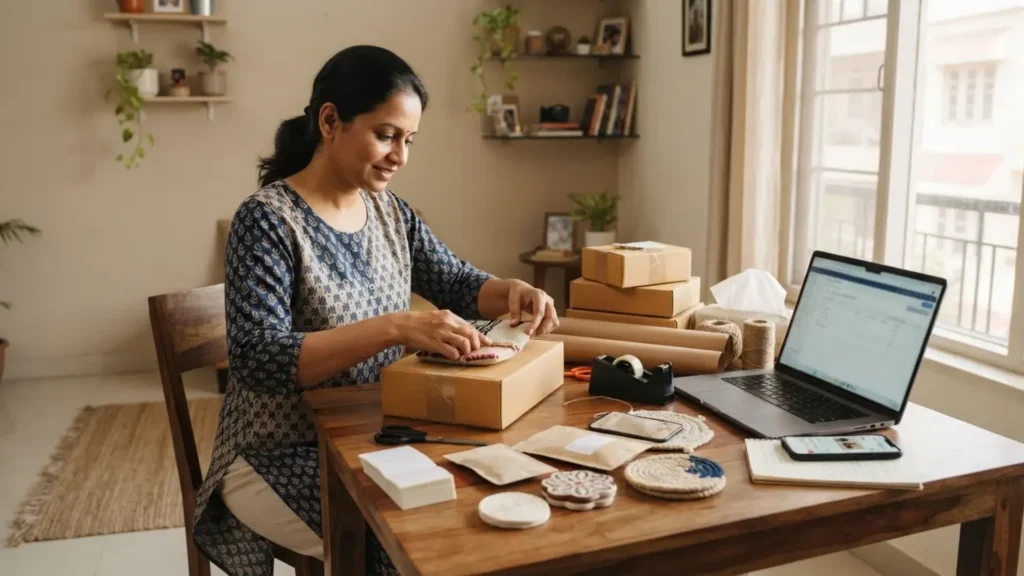
Show Real Examples of Your Work
Share product photographs, sample designs, short demonstrations, and customer feedback with permission.
For service businesses, examples of completed work can help customers understand the quality and scope of your service.
Encourage Repeat Business
A satisfied customer may return or recommend you to someone else. Focus on consistent quality, transparent pricing, and dependable delivery.
Do not spend heavily on paid advertising until you understand which products, services, and customer groups generate worthwhile enquiries.
Common Mistakes to Avoid
Low-investment businesses can still lose money if early decisions are poorly planned. Watch out for these common mistakes:
- Choosing an idea only because it is trending: A popular business may already have intense competition in your area.
- Spending before testing demand: Buying equipment or stock before speaking with customers can leave money tied up in an unproven idea.
- Ignoring operating costs: Packaging, delivery, repairs, software, and utilities can reduce the money left after sales.
- Setting prices too low: Your price should cover direct costs, operating expenses, and a reasonable return for your work.
- Offering too many products at once: A focused selection is easier to manage and evaluate.
- Ignoring compliance: Check applicable registrations, tax responsibilities, and industry rules before starting operations.
- Expanding too quickly: Add equipment, staff, or inventory when customer demand and cash flow justify the expense.
Frequently Asked Questions
Which business can I start in India with very little money?
Online tutoring, freelance writing, basic graphic design, and some digital services can be started with relatively little equipment if you already have the required skills. Your main investment may be time, internet access, and a suitable device.
Which home-based business is suitable for beginners?
Online tutoring, tailoring, home baking, tiffin services, handmade products, and freelance work are possible home-based options. The right choice depends on your skills, available space, local demand, and applicable permissions.
Are service businesses better than product businesses for low investment?
Service businesses can be easier to test because they may not require inventory or storage. Product businesses can also begin on a small scale, but they often involve material costs, packaging, delivery, and unsold stock. Neither model is automatically more profitable.
Can I start a small business without renting a shop?
Yes. Some businesses can operate from home, online, or through customer visits. However, home-based operations may still be subject to local rules, residential restrictions, tax requirements, and industry-specific regulations.
Is Udyam registration necessary to start a small business?
Udyam registration is not a universal requirement for every business. It is an official MSME registration process for eligible enterprises. Check the government portal to understand eligibility and its potential benefits.
Do I need GST registration for a small business?
It depends on your business activity, turnover, location, and applicable GST provisions. Some businesses have registration obligations that depend on factors beyond turnover alone. Verify your position through official GST resources.
How can I know whether a business idea will work?
Speak with potential customers, study competitors, calculate your costs, and test a small offer. A few genuine paying customers provide more useful early feedback than social media likes or informal expressions of interest.
Final Thoughts
The best low-investment business is not necessarily the one with the lowest starting cost. It is the one that matches your skills, serves a genuine customer need, and can be operated within your available budget.
If you have a professional skill, consider tutoring, writing, design, bookkeeping, or digital services. If you prefer making or selling products, explore a small food business, tailoring, personalized gifts, or online reselling. Local services such as cleaning, repair, and event decoration may also be worth testing where demand exists.
Start with a focused offer, speak to potential customers, and calculate your costs before investing heavily. Once you understand what people are willing to buy and can deliver consistently, you can improve the business and expand at a manageable pace.
seoaiagent
Practical business guides, useful tools, and technology insights from BusinessNexa.



Work smarter with practical business tools.
Explore useful calculators, guides and tools for modern businesses.